

David Suzuki to speak at Nelson forest rally, November 18th.
Forest activist Jennifer Houghton explains how watershed clearcuts can devastate communities.
Federal budget guts climate action, an economist explains.
LISTEN OR DOWNLOAD THE NOVEMBER 11 SHOW
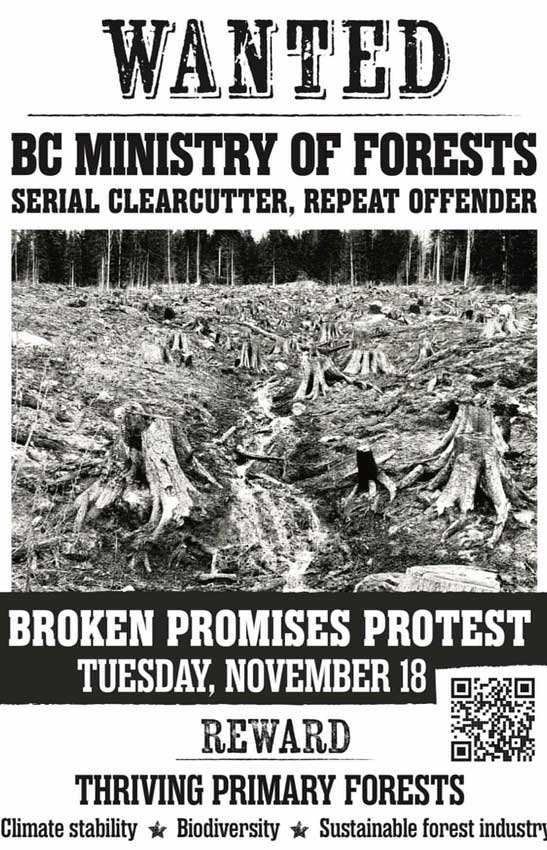
David Suzuki is coming to Nelson to speak at a rally to save old growth and primary forests on Tuesday, November 18th. It’s one of many of public protests happening right across the province. Joe Karthein with Save What’s Left tells us about it.
Jennifer Houghton, originally from Grand Forks, talks about how clear-cutting watersheds caused a flood of over one hundred houses, including hers, back in 2018. She explains how important intact watersheds are to the stability of our water systems.
Last week, the Carney Liberal government brought down its first budget and it was devastating for climate action in the country. It looks a lot like business-as-usual as economist Hadrian Mertins-Kirkwood tells us from the Canadian Centre for Policy Alternatives in Ottawa.
The EcoCentric is hosted by Keith Wiley and Solita Work. Noon Tuesdays on Kootenay Coop Radio 93.5 FM in Nelson and area and around the world on KootenayCoopRadio.com. The show is rebroadcast Sunday mornings at 9. After November 11, find the link to this episode here: TheEcoCentricRadioShow.ca.
LINKS. WHERE TO FIND OUT MORE
Save What’s Left on facebook
https://www.facebook.com/groups/savewhatsleft/
BC Forestry Reform on Facebook
https://www.facebook.com/groups/1019165341760551
Boundary Forest Watershed Stewardship
https://boundaryforest.org/
Analysis of the Federal Budget from Canadian Centre for Policy Alternatives
https://www.policyalternatives.ca/news-research/the-path-to-prosperity-set-out-in-budget-2025-leaves-millions-behind/
COMING EVENTS
Sunday Nov 16 1 pm
Taghum Hall
Friends of Falls Creek
Friends of Falls Creek is hosting a fundraising festival to support the Bonnington and Beasley communities against BC Timber Sales proposed commercial logging in the watershed. A day of music, thought, and gathering to show gratitude for nature’s life giving source.
Featuring music by Young Braised, Song Keepers Choir and Ryan Shane Owen.
Chef Rosh Kubelka of Hume Hotel will be sharing some of his favorite foods available for purchase.
Suggested donation $10, kids free. Water is life, water is love.
friendsoffallscreek.ca. https://www.friendsoffallscreek.ca/
Tuesday November 18 Noon
Protect old growth forests rally Nelson
Nelson City Hall
David Suzuki and Suzanne Simard will be speaking at a Broken Promises rally
against continued clearcutting of old growth and new threats of logging in parks.
Broken Promise protests will be taking place the same week at other communities across BC, including Victoria.
The best place for online information is on Facebook search: BC Forestry Reform.
Saturday, Nov 29, 2025, 1:30 pm
‘Exploring Wetlands’ photos and observations
West Kootenay Naturalists event
Shoreacres Hall, 2625 Shoreacres Rd,
The West Kootenay Naturalists present Exploring Wetlands by Jana Malinek, retired biology teacher, nature photographer and lifelong naturalist. Through stunning photos and thoughtful observations gathered while kayaking the small lakes of the West Kootenay, Jana reveals the rich plant and animal life of our local wetlands, and the intricate relationships that make these ecosystems so vibrant.
Prior to the presentation, the West Kootenay Naturalists host a potluck lunch at 12:00 and a club business meeting at 1:00. All are welcome.
For information, see wknats.weebly.com. https://wknats.weebly.com/
ENVIRONMENT NEWS BITS
The U.S., Canada, Australia, and Norway collectively increased their oil and gas production by nearly 40 percent since the Paris Agreement was adopted in 2015 to 2024.
At the same time, Global North countries paid only $280 billion in climate finance to the rest of the world since the Paris Agreement – while enabling the oil and gas companies they headquarter to make close to 5 times as much in profits (over $1.3 trillion) during the same period
A decade on from the Paris Agreement, fossil fuel extraction and use have continued to rise and hit record levels. As a result, the remaining carbon budget for keeping global warming to 1.5°C is now so small that it could be depleted in just three years if carbon pollution, primarily from fossil fuels, remains consistent.
The Drax power plant in the UK has continued to burn 250-year-old trees sourced from BC forests despite growing scrutiny of its sustainability claims, forestry experts say.
The report, by Stand.earth, a Canadian environmental non-profit, claims that a subsidiary of Drax Group received hundreds of truckloads of whole logs at its biomass pellet sites throughout 2024 and into 2025, which were likely to have included trees that were hundreds of years old.
The report could raise fresh questions for the owner of the North Yorkshire power plant, which has been forced in recent years to defend its sustainability claims while receiving more than £2m a day in green energy subsidies from UK bill payers.
The carbon offset global market reached more than $2bn (£1.5bn), in recent years propelled by a wave of enthusiasm for offsets as a solution to global heating and biodiversity loss. Companies bought the carbon offset credits theoretically cancelling out emissions from flying, fashion, food, fossil fuels and other sources During the pandemic, leading investment banks formed trading desks for offsets as prices surged from a few dollars to more than $30 a credit for some schemes.
But today, a large part of the money and enthusiasm for these schemes has dried up after a dramatic market collapse. Crucial flaws in the way credits were calculated indicated that the overwhelming majority of forest protection credits approved by Verra, the world’s leading certifier, massively overstated their impact.
A joint Guardian newspaper investigation in 2023 found that more than 90% of offsets did not represent genuine carbon reductions, according to independent research published by journals including Science, PNAS and Conservation Biology
Last weeks election from New York to Georgia to Washington, saw voters backing funding renewables, reining in energy costs, and building out mass transit. They also supported candidates promising to deliver those policies. On the whole, the results suggest Americans are pushing back against President Donald Trump’s efforts to roll back climate action.
Last week’s federal budget announced $40 million over two years for a Youth Climate Corps (YCC), starting in April 2026. It is good news for the hundreds of young activists and their allies (including many supportive members of Parliament) who have pressed hard for this idea,
While the government touts the budget as a “generational investment” for young Canadians, at $20 million a year, the YCC will produce roughly 350 full-time job. The initial program will not be terribly important for either tackling skyrocketing youth unemployment or addressing the climate emergency.
Hektoria glacier, “a glacier on Antarctica’s Eastern Peninsula experienced the fastest retreat recorded in modern history — in just two months, nearly 50 per cent of the glacier disintegrated.”
“Hektoria’s retreat is a bit of a shock—this kind of lightning-fast retreat really changes what’s possible for other, larger glaciers on the continent,” said Ted Scambos, a scientist at the University of Colorado. “If the same conditions set up in some of the other areas, it could greatly speed up sea level rise from the continent.”
https://phys.org/news/2025-11-antarctic-glacier-retreats-faster-modern.html
 Longest running Enviro News show on the Radio!