

LISTEN OR DOWNLOAD DECEMBER 17 SHOW HERE:
The author of Big Trees of the Inland Temperate Forest of BC, Terry Nelson, has surveyed many inland forests and among the many interesting stories he tells us the largest grand fir tree in BC grows right in the City of Nelson.
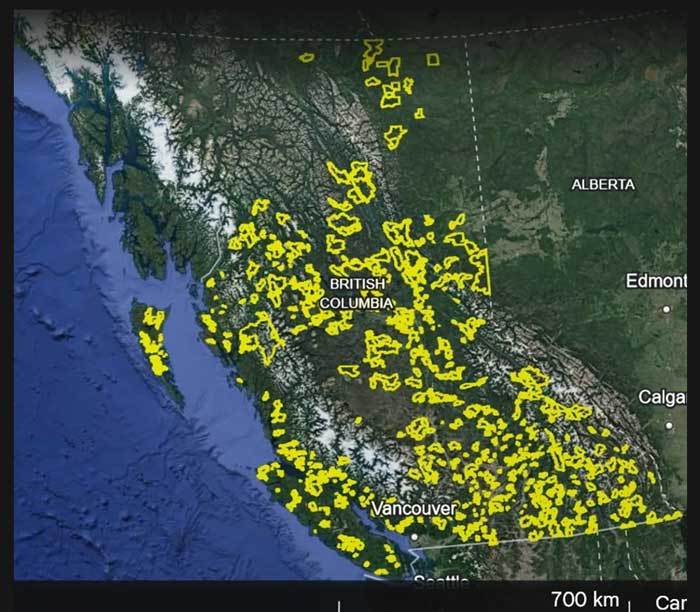
Forest protector Joe Karthein from SaveWhatsLeft.ca comes back on the show with some detailed updates on local Kootenay forests slated for clearcuts. There’s even glimmers of good news in the bad. He also tells us how his Save What’s Left group has expanded and taken on a lot more in the past year.
The Kootenay CarShare Coop’s new Executive Director Maxence Jaillet and marketing agent Karmelle Spence King talk about what’s news. There’s lots of progress in providing Kootenay folks with a car sharing alternative. They even do the draw for a special CarShareCoop contest right on the show.
LINKS MENTIONED
Big Trees of the Inland Temperate Forest
https://bigtreesbc.square.site/home
Save What’s Left BC
https://savewhatsleft.ca/
Kootenay CarShare Coop
https://www.carsharecoop.ca/
COMING ENVIRONMENT EVENTS
3 pm Sunday, December 22, 2024
4th Annual Santa Bicycle Ride
Nelson, Lakeside Park,
Dust off your Santa suit or holiday outfit, put Christmas lights on your bike and join the annual Santa Bicycle Ride. $10 dollar suggested donation. All proceeds are going to Our Daily Bread. (Just $60 provides ten meals for those in need.) Children are welcome!
Sign up on the West Kootenay Cycling Coalition facebook page.
Noon Wednesday, Jan 1st
NELSON Polar Bear Swim
Lakeside Park Nelson
Kootenay Co-op Radio (KCR) and the Friends of Kootenay Lake Stewardship Society (FOKLSS) invite you to ‘go jump in the lake’ and fundraise, all for a couple of good community causes.
This is a wonderful family friendly event that these two small non-profits take great pride in being able to bring to the community.
Register to swim and sponsor a dipper here: https://nelsonpolarbearswim.com/
Also coming up in January
Talk by Forest Scientist Suzanne Simard
Date TBA
The West Kootenay Watershed Collaborative Science Pub is hosting best selling author Suzanne Simard (Professor of Forest Ecology). The celebrated forest ecologist will be sure to draw a crowd.
https://www.westkootenaywater.ca/
ENVIRONMENT NEWS BITS AND LINKS
Catherine McKenna, Canada’s environment minister from 2015 to 2019 published a revealing comment in theToronto Star Newspaper last week.
McKenna said: As environment minister, I believed the oil sands sector would help us save the planet. I was wrong.
Her explanation followed:
“I really believed that the environment and the economy could go hand-in-hand and include a vibrant oil and gas sector. I was convinced that we could reduce emissions from the oil sands as part of an ambitious climate plan, finally showing to the world that Canada was committed to meeting our targets and doing our part to tackle the climate crisis.
“It turns out the consensus was a mirage. Or, more accurately, a sham. Maybe it shouldn’t have surprised me that our industry partners were working against us from the inside. After all, oil is their business, their bottom line.”
https://archive.ph/2SAuZ#selection-4865.0-4881.0
The BC NDP and BC Greens signed a cooperation deal last week, including some steps to boost intercity public transporation. The NDP also agreed to a review of its CleanBC program a year early, and to review the province’s forest management program, with the Greens to be “fully involved” in both reviews. The transit boosts will start with more buses on the Sea To Sky highway, and will also see services improved along Highway One and Highway 16. No expansions were announced for the Okanagan or Kootenays.
Paris is Replacing Parking Spaces With Trees.
The city’s new climate plan promises to drop speed limits, repurpose traffic lanes, remove 60,000 parking spots and create urban “oases” to combat extreme heat.
By 2030, Paris will have removed 60,000 parking spaces and replaced them with trees. That’s outlined in the French capital’s new 2024-2030 Climate Plan, which was released last week and will soon be voted on by the Council of Paris.
Paris has already received much international attention for the steps it has taken to reduce carbon emissions in recent years, especially in the decade since Mayor Anne Hidalgo took office. Under the heading “Faster, Fairer, More Local,” this new plan pledges to extend that progress, delivering a city that’s greener, more resilient against extreme weather, more pedestrian-friendly — and freer of cars.
The Ontario government has pushed forward plans to boost natural gas generation to meet soaring energy demand, despite receiving expert advice to “plan a partial abandonment” of gas infrastructure by 2050.
The expert advice came in a report commissioned by the Doug Ford government but never released publicly. The Narwhal magazine reviewed a copy of the independent study, which was valued at up to $1.5 million.
The expert report states, “natural gas is mostly phased out in all pathways” to net-zero, finding the methane-heavy fossil fuel should no longer be used in buildings, and mostly be removed from transportation. It predicts gas will continue to be used marginally for heating by 2050, and it urges the government to strongly promote the adoption of electric heat pumps.
Electricity, the report says, should come in large part from nuclear generation, which could make up 64 per cent of the energy supply by 2050, up from 35 per cent capacity today. And significantly, the report recommends Ontario increase wind energy five-fold.
The federal government tried last week to put responsibility on the provinces to bring down greenhouse gas emissions as it released a national emission reduction target for 2035 that is only a little more ambitious than its existing 2030 goal.
Veteran climate policy analysts and experienced international climate negotiators said there were many other directions the government could have taken.
The 2035 target calls for Canada to reduce its emissions by 45 to 50% from 2005 levels, CBC reports, a goal that amounts to a 41% reduction in just a decade. Last month, federal Environment Commissioner Jerry DeMarco warned the country is falling short of its 2030 target of 40 to 45%.
The Arctic tundra has tipped over into becoming a source of atmospheric carbon, with the region now emitting more carbon dioxide than it stores, the U.S. National Oceanic and Atmospheric Administration (NOAA) reported last week.
“When including the impact of increased wildfire activity, the Arctic tundra region has shifted from storing carbon in the soil to becoming a carbon dioxide source,” the agency said last week in a synopsis of its 2024 Arctic Report Card. “Circumpolar wildfire emissions have averaged 207 million tons of carbon per year since 2003.”
Major clean electricity announcements swept through provinces representing three-quarters of Canada’s population this week, even as the province with by far the highest greenhouse gas emissions doubled down on a period of deep uncertainty for renewable energy developers and investors.
British Columbia announced nine new wind power projects totalling 1,531 megawatts of new capacity. B.C. said the deal would bring C$5 to $6 billion in private investment into the province, with eight of the nine projects 51% owned by First Nations. The average power price was about 40% lower than what provincial utility BC Hydro paid in its last call for clean power in 2010., the province said.
On Wednesday, Ontario said it would increase its upcoming power purchase, already the largest in its history, from 5,000 to 7,500 MW
Then a day later, Quebec and Newfoundland and Labrador unveiled a tentative but still “monumental” agreement deal to redistribute revenues from the massive Churchill Falls hydropower project.
 Longest running Enviro News show on the Radio!