
LISTEN OR DOWNLOAD THE OCTOBER 29 SHOW HERE:
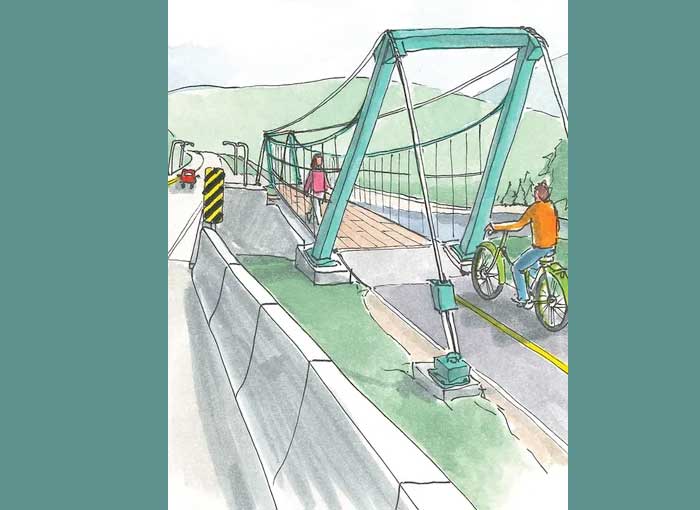
Last week the Ontario government introduced a law to limit and possibly remove new bike lanes in the province. Michael Longfield from Cycle Toronto tells us what’s wrong with the plan. The West Kootenay Cycling Coalition envisions a new footbridge at Taghum as part of a Nelson-Castlegar cycle and people path. Trish Johnstone lives in Beasley and cycles often to Nelson and says the current traffic bridge is frightening. In the West Kootenay there is a skeleton network of bus services running too infrequently to be useful for most residents. Blaine Cook from Slocan Lake tells us how much more frequent buses would help lots of people.
LINKS MENTIONED:
CYCLE TORONTO
Keep Our Bike Lanes Safe and Passable https://www.cycleto.ca/
West Kootenay Cycling Coalition’s Nelson-Castlegar Corridor proposal
https://westkootenaycycling.ca/projects
Check out the West Kootenay Transit bus schedule on BC Transit
https://www.bctransit.com/west-kootenay/schedules-and-maps/
ENVIRONMENTAL EVENTS
October 28 – 30
Canada’s Fair Share
A Virtual Summit on Global Climate Equity
started online yesterday and continues today and tomorrow.
Experts from around the world will be speaking in panel discussions on three key issues: Climate Finance; Trade and tax justice; and Financial Institutions and Debt
They say Canada has lagged in its obligations to the international community, and today we hear renewed calls from Global South leaders and social movements for greater solidarity from Canadian civil society as the climate crisis closes in.
https://www.climatefairshare.ca/
7 pm Saturday, November 2, 2024
Snk’mip: Dig Deeper, feature documentary
Nelson United Church.
The feature documentary about reviving the marsh at the north end of Slocan Lake and building right relationship with the Sinixt people who have lived here for thousands of years.
Saturday, Nov 16, 2024, 8:00 am
Hope in Action – Facing Climate Challenges
Free community symposium hosted by the Creston Valley Climate Action Society.
Creston, 128 16 Ave N, Creston, BC V0B 1G0, Canada
Speakers include:
Seth Klein, policy expert, climate activist and author of A Good War (joining remotely);

Robin Louie, Yaqan Nu?kiy traditional knowledge keeper and land user;

Laura Francis, community animateur and net zero grower.
Workshops featuring Kootenay-based experts will share the wisdom of Indigenous knowledge, ways to better manage our watersheds and forests, advocate to the government, and engage our community to work together to face the climate emergency. The day includes an expo of businesses, organizations and projects that are making a difference here in the Kootenays.
For more information please contact: crestonclimateactionsociety AT gmail com
Wednesday, November 20, 2024 | 4pm – 6pm
TEDxSelkirk College Countdown
Castlegar Campus, The Pit
Turn Ideas into Action
In the spirit of ideas worth spreading, TEDx Countdown is a global initiative to champion and accelerate solutions to the climate crisis, turning ideas into action.
A new hardhitting documentary about the Wet’suwet’en struggle to defend their lands is available to watch anytime. The title of the film is Yintah, the Wet’suwet’en word for their lands. Yintah is free to watch antime on CBC Gem.
ENVIRONMENTAL NEWS BITES
Faced with worsening climate-driven disasters and an electricity grid increasingly supplied by intermittent renewables, the US is rapidly installing huge batteries that are already starting to help prevent power blackouts.
The US is adding utility-scale batteries at a dizzying pace, having installed more than 20 gigawatts of battery capacity to the electric grid, with 5GW of this occurring just in the first seven months of this year, according to the federal Energy Information Administration (EIA).
This means that battery storage equivalent to the output of 20 nuclear reactors has been bolted on to America’s electric grids in barely four years,
https://www.theguardian.com/environment/2024/oct/24/power-grid-battery-capacity-growth
Governments’ current climate policies and promises have the world on track for “catastrophic” average global warming of 2.6° to 3.1°C, and the odds of limiting global heating to the 1.5°C target in the Paris climate agreement are rapidly shrinking toward zero, the United Nations Environment Programme (UNEP) warns in the latest edition of its annual Emissions Gap Report.
UNEP says global greenhouse gas emissions hit another new record last year at 57.1 billion tonnes of carbon dioxide equivalent (CO2e), a 1.3% increase from 2022. On a global scale, the power sector was the biggest climate polluter, at 15.1 gigatonnes, followed by transportation at 8.4 Gt, and agriculture and industry at 6.5 Gt each. G20 countries accounted for 77% of global emissions, compared to 5% from Africa and 3% from the world’s 47 least developed countries.
An 8,000-tonne liquid carbon leak at the United States’ first commercial site for underground carbon dioxide storage is setting off alarm bells for more than 100 other projects that might use similar materials.
The leak at a sequestration well below Lake Decatur in Illinois, operated by agribusiness giant Archer Daniels Midland, was likely caused by corrosion in the steel that was used to build the storage well, Politico PRO reports. More than 150 environmental groups are asking for a pause on carbon sequestration activities, while the U.S. Environmental Protection Agency (EPA) reassesses more than 100 pending permit applications.
Greenpeace is going to trial in February 2025 for a case brought against them by big oil
The attack started in 2017 when Energy Transfer, the oil company behind the Dakota Access Pipeline, sued Greenpeace USA. They claim that Greenpeace orchestrated the entire resistance at Standing Rock. Greenpeace says that is ridiculous and the oil company is trying to rewrite history and erase Indigenous leadership from one of the most powerful protests in history.
Greenpeace says the lawsuit for $400 million would completely bankrupt the oranization if it succeeds.
The Canadian government will announce plans for a high-speed train linking Quebec City and Toronto in the coming weeks, Radio-Canada has learned.
Proponents of the project hope the train will take passengers from Montreal to Toronto in three hours. By car, it takes about five-and-a-half hours to travel between the two cities.
Sources told Radio-Canada the train will travel 300 kilometres per hour — double the speed of Via Rail’s current trains.
Ottawa announced plans back in 2021 to build what it called a “high-frequency” (HFR) rail corridor with stops in Toronto, Peterborough, Ottawa, Montreal, Trois-Rivières, Laval and Quebec City. Sources told Radio-Canada the federal government has now decided the Toronto-Quebec City link will be high-speed.
https://www.cbc.ca/news/politics/high-speed-rail-canada-1.7365835
Alberta’s $7-million advertising campaign against federal limits on greenhouse gas emissions is boosting claims by the oil and gas industry that could be considered greenwashing, but legal experts say it’s unlikely governments can be held accountable under the same legislation.
The ads, placed prominently on the covers of major daily newspapers in four Canadian provinces in mid-October, directed people to an Alberta government website, ScrapTheCap.ca. The site argues against a proposed national emissions cap, repeating the claim that it is actually an oil and gas production cap.
Meanwhile the climate campaigning organization 350.org launched a counter website: scrapthecrap.ca.
The United States oil and gas lobby wants to dismantle climate regulations brought in by the Biden administration. They are clearly backing Trump in the deadheat race. If Trump wins, the U.S. industry is ready to move into a new era of political dominance, secure in its ability to continue expanding production and boosting its emissions of greenhouse gases.
Clean energy is challenging the dominance of oil and gas, and oil industry leaders biggest fear is entering a state of terminal decline, says independent journalist Jonathan Mingle writes in a guest essay for the New York Times. “If Kamala Harris wins the presidency, she could hasten the arrival of that moment by pursuing policies and regulations that would lead to lower consumption of oil and gas.”
The costly and contentious TransMountain pipeline expansion finally opened in May to triple the capacity of the existing line carrying tarsands crude from Alberta to the British Columbia coast, writes the Canadian Press.
Canadian production is smashing records, with crude output averaging five million barrels per day as of July—up from 4.8 million in 2023—and set to grow further into 2025.
The surge in oil exports is mainly going to Asia. Shipments have grown from nearly zero before the expansion to a monthly average of $325 million.
But the TransMountain business viability remains in question. The International Institute for Sustainable Development (IISD) warns that taxpayers could end up paying $18.8 billion to subsidize the pipeline, potentially amounting to about $1,255 per household, writes The Narwhal.
The world leader using Electric Vehicles, EVs is Norway, even though its Europe’s biggest oil and gas producer. 96.4 per cent of cars sold in Norway in September were electric. And as of September, electric cars outnumber gas and diesel burners in Norway. Canadian media are often reporting falsely that electric vehicle sales are stalling. In Canada, EV sales continue to grow steadily, from about 1% of sales in 2017 to 13% earlier this year. In Canada and even in the US, EV sales continue to set higher records every year. The CEO of Ford, Jim Farley says he personally drives a Chinese made Xiaomi SU7 and that American car producers are far behind China in tech.
https://www.nationalobserver.com/newsletters/zero-carbon
Governments’ current climate policies and promises have the world on track for “catastrophic” average global warming of 2.6° to 3.1°C, and the odds of limiting global heating to the 1.5°C target in the Paris climate agreement are rapidly shrinking toward zero, the United Nations Environment Programme (UNEP) warns in the latest edition of its annual Emissions Gap Report.
UNEP says global greenhouse gas emissions hit another new record last year at 57.1 billion tonnes of carbon dioxide equivalent (CO2e), a 1.3% increase from 2022. On a global scale, the power sector was the biggest climate polluter, at 15.1 gigatonnes, followed by transportation at 8.4 Gt, and agriculture and industry at 6.5 Gt each. G20 countries accounted for 77% of global emissions, compared to 5% from Africa and 3% from the world’s 47 least developed countries.
 Longest running Enviro News show on the Radio!