
LISTEN NOW OR DOWNLOAD OCTOBER 8 ECOCENTRIC
Kootenay Central candidates tell us their views on climate action and the environment at last week’s public forum. We have clips from three candidates on forest policy, climate policy and LNG and fossil fuels.
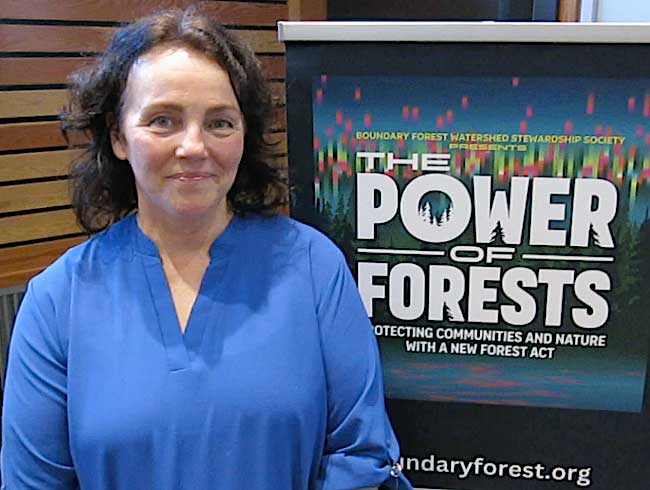
Last week also saw a forest policy announcement in Nelson form the Boundary Watershed Stewardship Society. They are promoting a new Forestry Act for BC as the only way to safeguard nature and the forests in the province. Jennifer Houghton tells what’s involved and what they are doing.
Some fun songs as well including one about BUGS!
LINKS MENTIONED:
Youtube Video of the full Kootenay Central Candidate Forum on Climate, Forests and Fires and the Environment.
https://youtu.be/eN0oI9SrOVI?si=adTuIUw7Dp7QrKEd
Boundary Forest Stewardship Society
https://boundaryforest.org/
Gaming the ecosystem: the truth about salvage logging
from Conservation North in Prince George
https://youtu.be/CUElSPw__Nk?si=Sh5-uiir1oal4uqG
VOTE BETTER TRANSPORT BC Campaign
https://votebettertransportbc.ca/
EVENTS COMING UP
Tonight Tuesday, October 8th
The BC Leaders Debate is live broadcast at 5 pm tonight. It’s fun to watch with friends and even people you disagree with. the Frack Free BC campaign is holding a rally outside the Vancouver CBC Studio to greet party leaders and “call out plans to build a new dirty fracked gas pipeline in northern BC. For the rest of us, it’s easy to watch on any device through cbc.ca at 5 pm.
6:30 pm Monday, October 21st and ongoing
Online
Community Care and Repair BC gathering
Community Care & Repair is a series of bi-weekly online learning and practice sessions to build the skills and connections we need to create communities of belonging, grounded in principles of nonviolence, emergence, Nonviolent Communication and collective liberation.
You can register online at: https://communitycareandrepair.sutra.co/space/ok27md/content
7 pm Wednesday, October 16th
Are you listening? A one-woman show by Zaynab Mohammed
Mir Centre for Peace at Selkirk College 301 Frank Beinder Way, Castlegar
A one-woman show about a woman who loses her innocence at a young age due to cultural inequity but finds freedom by listening to herself, others and the earth.
https://www.facebook.com/share/SFn8oavDwQ4VRaeK/
7pm Thursday, October 24th
Torchlight Brewing in Nelson
This one time – an evening of outdoor adventure stories from inspiring women+
Join us for a fun evening featuring local storytellers,
a silent auction with fantastic items from local brands, outdoor
companies and more. All in support of building backcountry mentorship opportunities for marginalized genders including women, women-identifying individuals, non-binary, and gender non-conforming people.
7 pm Friday, October 11, 2024
Snk’mip: Dig Deeper, feature documentary
Old Theatre in Castlegar
The feature documentary about reviving the marsh at the north end of Slocan Lake and building right relationship with the Sinixt people who have lived here for thousands of years.
A whole series of showing are coming up:
7 pm Saturday, October 12
At the VAllican Whole
7 pm Sunday, October 13
Langham Theatre Kaslo.
ENVIRONMENT NEWS
Robert Howarth’s analysis of the greenhouse gas footprint of LNG produced in and exported from the U.S. and published results in Energy Science and Engineering,
Howarth found that “the greenhouse gas footprint for LNG as a fuel source is 33% greater than that for coal” in terms of its 20-year global warming potential, and “even considered on the time frame of 100 years after emission… which severely understates the climatic damage of methane, the LNG footprint equals or exceeds that of coal.”
“This should be the final nail in the coffin for the false narrative that LNG was somehow a climate solution,” Henn added in a statement. “This now peer-reviewed paper demonstrates that LNG is worse for the climate than coal, let alone clean energy alternatives. Approving more LNG exports is clearly incompatible with the public interest.”
https://www.commondreams.org/news/lng-climate-change
Restricting the volume of high-emitting vehicles roaming city streets carries many benefits, from clearing the air to quieting the urban din and beyond. Recognition of this simple fact has led to the proliferation of clean air zones, designated regions within a city where vehicles must meet strict pollution standards or pay a fee to operate within it. At last count, over 300 such areas had been established across Europe. In London, which boasts the largest ultra-low emissions zone in the world, a study has found a secondary benefit: Kids started walking and biking to school more.
In the first of many papers expected from the study, the researchers found that, a year after the ultra-low emissions zone took effect, 2 out of every 5 London students in the study had switched from “passive” to “active” ways of getting to school.
https://grist.org/cities/london-fining-polluting-cars-more-active-kids/
Canada’s oil and gas industry must begin backing its pledges and pronouncements with real emission reductions, the editorial board of the Globe and Mail declared in a statement published September 30.
For Canada to make “significantly more progress” on emission reductions, “the oil industry must deliver on its promises,” writes the Globe, which general styles itself as Canada’s newspaper of record.
“Instead, it appears to be moving slowly, and awaiting a possible change in government. The federal Liberals are poised to institute a cap on oil and gas industry emissions, but such a policy will likely be scrapped by a Conservative government, if opinion polling holds through to an election in the coming year.”
Drawing on analysis by the Calgary-based Pembina Institute, which has been tracking oil sands spending and emissions trends since 2022, the Globe notes that fossil fuel production in Canada is up 26% since 2015, the year the Trudeau government came to power and countries adopted the Paris climate agreement. Since then, “Canada’s production of oil and natural gas has continually climbed higher to new records,” the editors write. “Oil production this year is set to average more than five million barrels a day for the first time, according to federal data. Natural gas output this year is also higher than it’s ever been.”
After last year’s off-the-charts, record-breaking wildfire season in 2023, this year may have felt like a reprieve — at least in some parts of the country.
But this past summer was still far above normal by several measures — and experts say what transpired holds clues for what’s to come as the climate changes, primarily due to the burning of fossil fuels.
By the numbers, the 2024 wildfire season is on track to be the second-worst wildfire season in terms of area burned since 1995, with more than 5.3 million hectares burned so far. That trails far behind last year, when more than 15 million hectares burned.
“If we are always comparing it to last year as a reference, every other year will not be as bad. But I think we have to say that it was a bad year,” Boulanger said in an interview.
The 2024 season is consistent with what wildfire scientists have observed over the past half-century — an increase, decade over decade, in the area burned, he said.
https://www.cbc.ca/news/climate/wildfires-2024-charts-1.7341341
 Longest running Enviro News show on the Radio!