LISTEN OR DOWNLOAD FEBRUARY 13 SHOW
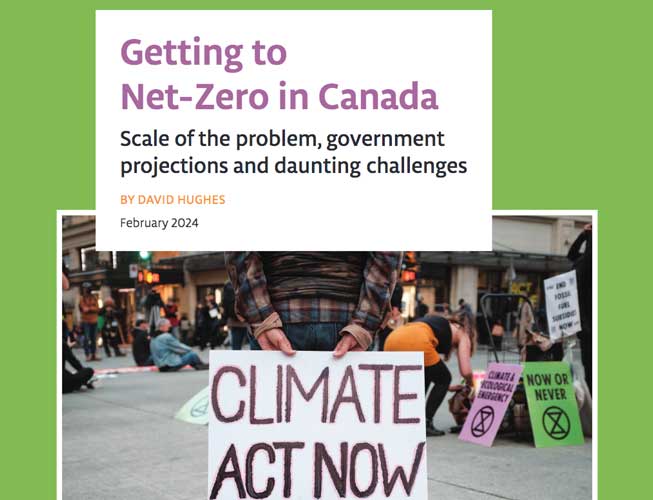
Geologist David Hughes worked for 32 years with Geological Survey of Canada now he’s come out with a new report on Canada’s plans to reach Net Zero carbon emissions by 2050. It turns out we have to change far more than the long-shot official plan to actually meet the target.
There are more than 200 grassroots climate campaigning groups in BC. The West Coast Climate Action Network helps the groups increase awareness of the solutions to the wild weather crisis. Author and activist, Guy Dauncey from Vancouver Island was one of the instigators of the Action Network. He tells us about some of the wide range of climate work being taken on all across the province.
LINKS MENTIONED IN THE FEBRUARY 13 SHOW
Getting to Net-Zero in Canada Geologist David Hughes’ detailed analysis of the scale of the problem, government projections and daunting challenges. This report underscores the need for a comprehensive strategy with practical, scalable solutions and a robust policy framework that will steer Canada toward a sustainable, net-zero future by 2050.
From the Canadian Centre for Policy Alternatives: https://policyalternatives.ca/netzero
The Office of the Auditor General says delays in implementing important net-zero regulations is one of the most significant barriers to delivering emissions reductions. This highlights the need to quickly move to cap emissions from the oil and gas sector, align private finance with net-zero, finalize clean electricity rules, and phase out gasoline powered car and truck sales by 2035.
Auditor General’s Report comments
The Commissioner of the Environment and Sustainable Development (CESD) says the story from 1990 to 2019—which is the full time span for which we have data—has been about a 20% increase in emissions over successive governments, from the first commitment in the green plan to Rio, all the way to the present, so there have been a series of failures followed by failures and other failures.[26]
https://www.ourcommons.ca/DocumentViewer/en/44-1/PACP/report-13/page-18
Andrew Nikiforuk’s article on Hughes’ study: A New Report Maps Canada’s ‘Daunting’ Path to Net-Zero Carbon
https://thetyee.ca/Analysis/2024/02/08/Canada-Daunting-Path-Net-Zero-Carbon/
The West Coast Climate Action Network. We-CAN, BC’s climate connection
https://www.youtube.com/watch?v=D5w55pTfSfY
ENVIRONMENTAL EVENTS
Tuesday, Feb. 13, 7-8:30 pm
Nelson Rod & Gun Club, 801 Railway St
Cottonwood Creek Revival Project Community Meeting
Living Lakes Canada, Friends of Kootenay Lake, and the Nelson District Rod & Gun Club Conservation Society are holding a public meeting about the Cottonwood Creek Revival project. They are presenting a recent technical report and community members will be able to share their concerns during an interactive session.
Thursday, February 15, 5 pm
Nelson Museum and Art Gallery
Pollination Pathways Research to Action
Kootenay Native Plant Society researchers are showcasing their discoveries driving the recovery of pollination networks in the West Kootenay region. This Thursday, February 15th it’s
Plant it and they will come featuring Brenda Beckwith and Janice Arndt presenting: Blossoms and Butterflies in BC Parks, followed by Valerie Huff with: Milkweed and Monarchs in the West Kootenay.
Friday, February 16
Online: Noon to 1 pm registration required
Climate Hub Webinar: Innovative community buildings
West Kootgenay Climate Hub is celebrating several innovative community buildings in our communities that make a difference for the climate and community.
Nasukin (Chief) Jason Louie will share the story of the Wilfred Jacobs Building, a newly opened centre offering community and health services to members of the yaqan nukiy (Lower Kootenay Band) First Nation.
Tammy Verigin-Burk, Executive Director of Castlegar Chamber of Commerce, will share about “The Confluence” — the Castlegar Visitors Centre and Chamber of Commerce building under construction.
Morag Carter, Executive Director of the Skills Centre in Trail, will share about their current project retrofitting a large community building in Trail to create a fully inclusive, climate friendly, community building.
TO REGISTER: WestKootenayClimateHub.ca
ENVIRONMENT NEWS BITS
The Sinixt Confederacy and Colville Tribes issued a statement last week calling for a full environmental impact assessment of the proposed Zincton all-season resort. Chair person Jarred-Michael Erickson said the current Environmental Overview Report does not consider the cumulative impacts of the proposed Controlled Recreation Area and development of private property in the project.
The Zincton project is in the London Ridge area east of New Denver, in the heart of Sinixt traditional territory.
This week the Slocan village council voted to join the Sue Big Oil class action lawsuit. The vote was unanimously in favour of the motion from Slocan Councillor Jordan Knott. Sue Big Oil is the BC campaign to get municipal damages paid for climate disasters by the world’s largest oil conglomerates. For decades, oil and gas corporations have known that burning fossil fuels would cause the heat waves, wildfires, drought and flooding that we’re now experiencing in BC. Slocan joins other smaller communities, Qualicum Beach, Squamish, and View Royale, who have voted to join the campaign.
SueBigOil.ca
Last week a jury awarded $1 million US to climate scientist Michael Mann, who sued a pair of conservative writers 12 years ago after they compared his depictions of global warming to a convicted child molester.
Mann, a professor of climate science at the University of Pennsylvania, rose to fame for a graph first published in 1998 in the journal Nature that was dubbed the “hockey stick” for its dramatic illustration of a warming planet.
The work brought Mann wide exposure but also many skeptics, including the two writers Mann took to court for comments that he said affected his career and reputation in the U.S. and internationally.
Canadian writer Mark Steyn in piece in National Review, referred to the scientist as “the man behind the fraudulent climate-change ‘hockey-stick’ graph, the very ringmaster of the tree-ring circus.”
https://www.cbc.ca/news/world/us-trial-mann-defamation-steyn-simberg-1.7110203
Low snowpack and ongoing drought are starting to impact summer events across BC and some events are being cancelled completely.
Last week, the Fort St. John International Air Show Society announced the cancellation of its much-anticipated August air show, because of wildfire risk in the ongoing drought in the Peace Region.
The Kamloopa Powwow Society has also rescheduled its annual three-day celebration, from August to June 28-30, to avoid extreme heat and potential wildfire smoke.
The Salmon Arm Folk Music Society has moved its annual Roots and Blues Music Festival, from August to July 26-28, also to limit risk of wildfire and smokej problems.
Ontario’s Independent Electricity System Operator (IESO) has signed up more than 100,000 households in six months for an electricity demand management program that is Canada’s biggest virtual power plant, and North America’s fastest-growing.
Each household in the Peak Perks plan getsa $75 to sign up and $20 each year they continue. They help the grid by turning their smart thermostats down during periods of peak electricity demand.
Peak Perks began last june and has been activated six times, and saved up to 54 megawatts of peak demand for an hour in early December. The saving allows the utility to hold off drawing power from expensive gas-fired plants.
Cornell University biogeochemist Robert Howarth has released a study showing LNG, liquified gas, can have over twice the climate impact of burning coal when it is shipped long distances. Coal releases almost twice as much carbon dioxide as LNG when the fuels are actually burned. But LNG’s methane emissions are “substantially higher”, based on methane’s climate impact over a 20-year span. Howarth concludes that LNG emissions are 12.3% higher than coal when the gas is carried over a shorter distance on a modern gas burning tanker, but LNG carries 2.7 times the climate punch on longer cruises in older tankers that burn heavy fuel oil.
On Monday, seven U.S. senators demanded a federal crackdown on a “dangerous greenwashing scheme” in the fossil fuel industry: producers hiring so-called gas certification companies to measure operations’ methane pollution so they can claim their gas is “preferable from a climate perspective.”
“Gas producers sometimes publicly describe their product as ‘certified,’ ‘responsible,’ or ‘differentiated’ and market it as a climate-friendly fossil fuel. But too often these green claims are false or misleading due to opaque methodology, unreliable technology, and unacknowledged downstream climate effects of gas combustion,” the senators explained.
https://www.commondreams.org/news/certified-gas
The Convention on the Conservation of Migratory Species of Wild Animals (CMS) opened its conference on the United Nations biodiversity treaty by releasing the first-ever State of the World’s Migratory Species report, showing that nearly half of migrating species are declining in population.
The crisis is especially dire for more than 1 in 5 species that are threatened with extinction, and 70 species listed under the CMS which have become more endangered, including the steppe eagle, the Egyptian vulture, and the wild camel.
The populations of nearly all species of fish listed in the U.N. treaty, including sharks and rays, have declined by 90% since the 1970s.
https://www.commondreams.org/news/migratory-species-extinction
 Longest running Enviro News show on the Radio!