
LISTEN OR DOWNLOAD THE SHOW HERE:
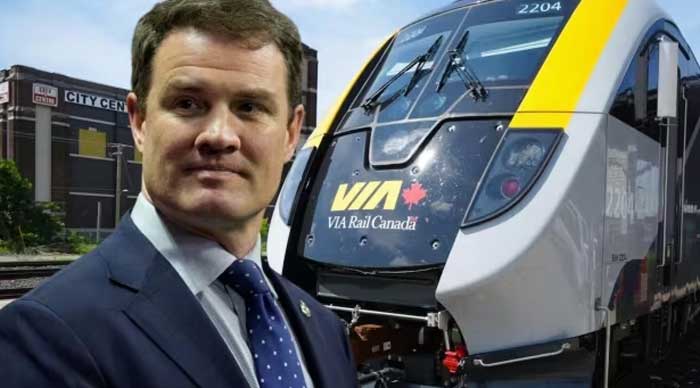
Skeena-Bulkley Valley Member of Parliament Taylor Bachrach is the NDP’s transportation critic and he decided to take the train home for Christmas to highlight the problems VIA Rail has getting delayed by priority for freight trains. He tells us about the trip and the future of train travel in Canada.
Dr. Gord Lovegrove is a University of BC at the Okanagan professor who has done a study on new local train travel systems in Canada and he tells us about one possible example, a local commuter train up and down the Okanagan, Osoyoos to Kamloops.
Tom Green is a senior climate policy advisors with the David Suzuki Foundation and he explains the plans and problems with the new federal framework for a hard cap on climate pollution from Canada’s oil and gas sector.
LINKS MENTIONED:
Taylor Bachrach, MP’s Private member’s bill aims to give passenger trains right of way over freight trains. On CBC.
Gord Lovegrove talked about Karlsruhe, Germany’s highly successful train-tram system. Here is one commentary on it: https://humantransit.org/2009/10/karlsruhe-the-tramtrains.html
The federal government is open to public input on the oil and gas emissions cap framework this month only. You can find a handy guide to submitting on the Foundation’s website at DavidSuzuki.org. Look under ACTION. https://davidsuzuki.org/action/cap-and-cut-oil-and-gas-emissions/
EVENTS:
Friday, January 19 Noon Hour
West Kootenay Climate Hub online Webinar
The West Kootenay Climate Hub noon hour webinars are starting up January 19th with Craig DeLong, from Kootenay Outdoor and Environmental Learning Society.
His presentation will be focused on adaptation and mitigation strategies for smaller communities. Learn how we can better protect our communities from the increasing threat of wildfire. He’ll also be suggesting how individuals and communities can decrease greenhouse gas emissions by focusing on changing how we drive and initiatives to reduce supply chain contributions.
Find out more and register for the event on WestKootenayClimateHub.ca.
Wednesday, January 24th.
on Hour Webinar working with the BC Utilities Commission
And if you are a real policy wonk, there’s a webinar coming up on intervening at the BC Utilities Commission. The BCUC makes crucial energy rulings for the province and helps direct our energy development, all in the public interest. The BC Sustainable Energy Association has been intervening in BCUC cases for years and are holding a free webinar on how to do it well.
Join Bill Andrews, BCSEA Lawyer for BCUC, and Tom Hackney, BCSEA Policy Advisor, as they reflect upon past accomplishments and share a glimpse into future challenges.
Thursday February 15th, 6:30pm-8:30pm
Climate Action Provincial Assembly (CAPA) Part 1
From WE-CAN: By joining our 6th Climate Action Provincial Assembly you will be able to: (1) Hear ten of BC’s most effective climate leaders with their five-minutes answers to this question: “What are the three most effective things climate action groups and organizations can do to accelerate progress in BC’s climate movement?” (2) Participate in a break–out group with other climate activists to consider the speakers’ ideas, and ask how they might apply to the work of your climate action group. (3) Take their answers back to your group, and consider if you can use them to build a more integrated and powerful climate movement. Details here
ENVIRONMENT NEWS
Some First Nations and environmentalists are speaking out against a Canadian Nuclear Safety Commission’s approval of a proposed storage facility for radioactive waste that will be located very close to the Ottawa River.
Environmental concerns raised by Algonquin First Nations, local communiti3es and environmentalists didn’t sway the Commissioni. The industry proponents of the project maintained the facility is needed to address decades of legacy waste.
The “near-surface disposal facility,” referred to as the NSDF, will hold up to a million tonnes of radioactive and hazardous waste about one kilometre from the Ottawa River, where the land slopes away from the river. It will mainly store low-level legacy waste from Chalk River Lab’s 65 years of operations,
2023 “smashed” the record for the hottest year by a huge margin, providing “dramatic testimony” of how much warmer and more dangerous today’s climate is from the cooler one in which human civilisation developed.
The planet was 1.48C hotter in 2023 compared with the period before the mass burning of fossil fuels ignited the climate crisis. The figure is very close to the 1.5C temperature target set by countries in Paris in 2015.
Scientists at the EU’s Copernicus Climate Change Service (CCCS) said it was likely the 1.5C mark will be passed for the first time in the next 12 months. But scientists say it’s a likely trend and the records may well be broken again in 2024.
https://www.theguardian.com/environment/2024/jan/09/2023-record-world-hottest-climate-fossil-fuel
Just since 2020, the world’s five richest men have more than doubled their fortunes to $869bn (£681.5bn) while the world’s poorest 60% – almost 5 billion people – have lost money.
The details come in a report by Oxfam as the world’s richest people gather this week in Davos, Switzerland, for the annual World Economic Forum meeting of political leaders, corporate executives and the super-rich.
The yawning gap between rich and poor is likely to increase, the report says, and will lead to the world crowning its first trillionaire within a decade. At the same time, it warns, if current trends continue, world poverty will not be eradicated for another 229 years.
Climate advocates and frontline community leaders published a letter last week urging concerned individuals to join them in Washington, D.C., in early February for a sit-in at the Department of Energy where they will demand that it end the expansion of liquefied natural gas exports.
Stopping the LNG development has emerged as a priority for the climate movement in recent months. Just one proposed project, Venture Global’s Calcasieu Pass 2 (CP2) facility, would emit 20 times more climate pollution than the controversial Willow oil drilling project in Alaska. But CP2 is only one of more than 20 LNG export facilities planned for the Gulf Coast, which would have combined emissions that exceed those of the European Union or 850 coal plants, Stop LNG said in a statement.
The action is planned for February 6-8 at the Department of Energy in Washington.
https://www.commondreams.org/news/sit-in-end-lng
Global renewable energy capacity soared by 50 per cent in 2023. The massive increase was driven by record increases in Europe and the United States and what the International Energy Agency calls the “extraordinary” growth of solar farms in China.
2023 marked the 22nd year in a row that renewable capacity growth set a new record, according to a report released by the Paris-based energy watchdog Thursday. The IEA expects expansion through to 2028 will be the fastest yet, with global renewable capacity on course to increase by two-and-a-half times by 2030.
That means more renewable capacity will be added in the next five years than has been installed since the first commercial renewable energy power plant was built more than 100 years ago, the report says. The adoption of renewables, including solar, wind, hydropower, biofuel and others, is key to the world’s transition to the more sustainable energy systems needed to limit the worst effects of climate change.
In 2023, China brought online as much solar power as the entire world did in 2022, and its wind power generation grew by 66 per cent year-on-year.
“While the increases in renewable capacity in Europe, the United States and Brazil hit all-time highs, China’s acceleration was extraordinary,” the report says.
Canada’s forestry sector is responsible for far more greenhouse gas emissions than show up in official tallies, potentially leading to policies that aren’t in line with the country’s climate goals, a new study suggests.
The peer-reviewed study, published in the academic journal Frontiers in Forests and Global Change, found that annual greenhouse gas emissions attributable to forestry between 2005 and 2021 were, on average, nearly 91 million tonnes of carbon dioxide equivalent — which would put the sector on par with emissions from the agricultural sector.
Canada’s official inventory report shows the forestry sector acting as a carbon sink, which means it absorbs more carbon from the air than it sends into the atmosphere.
According to the study’s authors, the underreporting of emissions from the forestry sector comes from failing to account for all the carbon emissions associated with managed forests.
In particular, the government doesn’t count the emissions from things like insect outbreaks and wildfires (which produced a record amount of emissions last summer) as part of the forestry sector’s total.
https://www.cbc.ca/news/climate/canada-logging-emissions-1.7081906
The West Kootenay’s snow basin is just 57 per cent of what’s considered normal.
Data released last weeek by the provincial River Forecast Centre shows the snow basin’s records from Jan. 1. The Forecast Centre defines a normal snowpack as the average measurement recorded at a station between 1991 and 2020.
The latest update is far lower than what the snow basin had one year ago when it was recorded at 93 per cent.
The lack of snow isn’t limited to the West Kootenay. Snow packs are down across B.C., with a provincial average of 56 per cent.
The East Kootenay is 62 per cent of normal, while the Boundary region that includes Grand Forks is down to 58 per cent.
https://www.nelsonstar.com/local-news/west-kootenay-snow-basin-only-57-of-normal-7295031
Three Indigenous land defenders charged more than two years ago with defying a court order have been found guilty of criminal contempt in B.C. Supreme Court.
On Nov. 19, 2021, Sleydo’ Molly Wickham, Shaylynn Sampson, who is from the Gitxsan Nation, Corey Jocko, who is Haudenosaunee, were arrested in a separate structure located on a nearby worksite where Coastal GasLink was preparing to drill under the Morice River.
Justice Michael Tammen, who delivered his decision Friday, January 12 will now consider an application by all three to stay the charges based on alleged misconduct by RCMP officers during the arrests, which occurred along the Coastal GasLink pipeline route in Wet’suwet’en territory on Nov. 19, 2021.
https://thetyee.ca/News/2024/01/12/Court-Convicts-Indigenous-Land-Defenders-Alleged-RCMP-Violations/
 Longest running Enviro News show on the Radio!