
LISTEN OR DOWNLOAD SEPTEMBER 12 SHOW HERE:
The Regional District of the Central Kootenay opened its big organics composting facility near Salmo on Friday and KCR reporter Scott Onyshak reports.
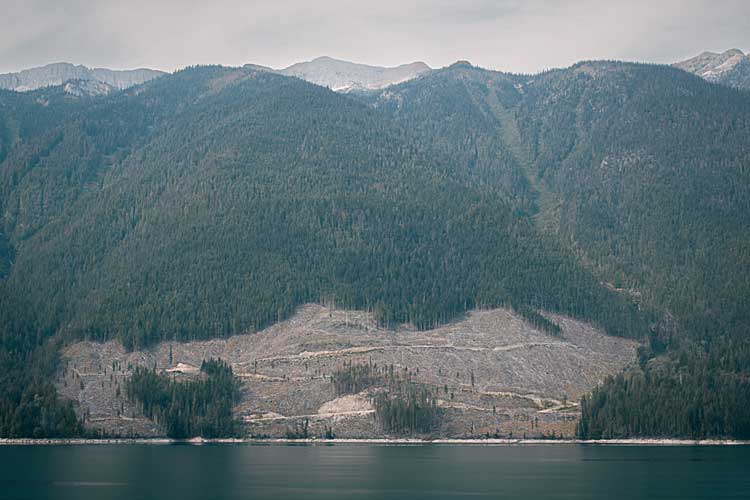
Logging trucks are rolling many of them coming from clearcutting the banks of the Duncan Reservoir. Fox Forest from Last Stand West Kootenay gives us a report.
In mid August the Wet’suwet’en nation held their annual Peace and Unity Summit in Smithers, with guests from far and wide. One of the speakers, Kai Nagata from Dogwood BC presented detailed research on the militaristic policing that has hit the Wet’swuwet’en land defenders, opposing the Coastal Gas Link pipeline.
LINKS REFERENCED IN THE SHOW:
Last Stand West Kootenay on Facebook https://www.facebook.com/search/top?q=last%20stand%20west%20kootenay
Wet’suwet’en Peace and Unity Summit https://peaceandunitysummit.com/. With video of full proceedings.
TheJuiceMedia’s HONEST GOVERNMENT AD recaps Kai Nagata’s expose of US military tactics against Wet’suwet’en land defenders. https://www.thejuicemedia.com/
Environment News
The onset of large, severe wildfires that threaten communities year after year has occurred earlier in British Columbia than previous research projected, and experts say the record-shattering 2023 season should spur us all into more action on the climate crisis.
Lori Daniels, a professor in the department of forest and conservation sciences at the University of British Columbia. says
A combination of climate change and entrenched forest management practices have created a landscape more conducive to large, high-intensity blazes.
“Society is already paying a huge cost for these climate change-fuelled fires,” she says.
“The thing we can control in the short term is the vulnerability of the landscape.”
Daniels recent research shows an “abrupt” uptick in wildfire activity in B.C. corresponding with a warming and drying trend that began in the mid-2000s.
The province has experienced its four most severe wildfire seasons on record during the past seven years, in 2017, 2018, 2021 and 2023.
https://www.cbc.ca/news/canada/british-columbia/bc-wildfires-climate-2023-1.6962307
__________________________________
As severe drought conditions have helped usher in British Columbia’s most devastating wildfire season on record, experts and elected officials are warning of increased flooding risks and lingering damage when wetter weather returns.
More than 80 per cent of B.C.’s water basins are experiencing Level 4 or 5 drought conditions, meaning ecological and economic damage are likely or almost certain, according to the province and environmental experts.
Tom Pypker, chair of the department of natural resource sciences at Thompson Rivers University. says
“We have groundwater levels dropping dramatically. We have river levels that are very, very low,”
The concurrent drought and unprecedented fire season are exacerbating one another and leaving the province increasingly vulnerable to severe flooding, according to experts.
In Vancouver’s Stanley Park, an unprecedented 25 per cent of the trees are dead and decaying due to several summers of drought that have prolonged a western hemlock looper moth infestation, according to the Vancouver Park Board.
https://www.cbc.ca/news/canada/british-columbia/bc-drought-impacts-1.6961982
__________________________________
Water levels in the Arrow Lakes Reservoir will continue to drop through September according to BC Hydro’s fall update. The lack of rain over the course of 2023 is blamed as a major contributing factor.
Most of the Columbia River valley is currently at drought level 5 (out of 5) and the rest of the Kootenay region is either at level 4 or 5.
During drought level 4, the B.C. government says adverse impacts to socio-economic or ecosystem values are likely. At level 5 adverse impacts are almost certain. Fears are being raised about the Kokanee spawn and fish survival generally on the Arrow Lakes.
__________________________________
More than 2,400 Dutch climate activists were arrested last Saturday for blocking the A12 highway in The Hague. Dozens of minors were among those arrested.
The climate action group Extinction Rebellion blocked the stretch of the highway and the Ministry of Economic Affairs and Climate Policy every day starting Saturday – until the government stops subsidies for the fossil fuel industry.
“On the first day of the permanent A12 blockade, many thousands of people showed that all fossil subsidies must end now. Every day all over the world, and especially in the Global South, people are dying from climate disasters that our government is paying for. This has to stop now.
Tessel Hofstede, spokesperson for Extinction Rebellion, said we will keep coming back every day at noon until all fossil subsidies are eliminated,”
https://nltimes.nl/2023/09/10/2400-climate-activists-arrested-a12-blockade-another-protest-underway
__________________________________
Scotland is embracing a fresh approach to its economy. In the spring, it appointed its first cabinet secretary for “wellbeing economy, fair work and energy,” tasked with developing “an economy that is fair, green and growing . . . to ensure our collective and individual wellbeing.”
Along with New Zealand, Iceland, Wales and Finland, Scotland rounds out the Wellbeing Economy Governments (WEGo) partnership of nations – all five explicitly working toward building economies “designed to serve people and the planet rather than the other way around.”
So far Canada has been sitting on the sidelines as an official observer at WEGo conferences, signalling an interest in economies focused less on profit and more on human and ecological well-being.
California has endorsed the Fossil Fuel Non-Proliferation Treaty. Last week the final vote in the State Assembly, made California the largest global economy to support the proposal. Facing big opposition from oil & gas lobbyists and 40 industry groups, who jtried to block it, the proposal was backed by a majority of 43 votes.
The resolution was co-sponsored by Indigenous Environmental Network, Stand.earth, and SAFE Cities. The resolution calls on President Biden to support Pacific nations moving ahead with seeking a negotiating mandate for a Fossil Fuel Non-Proliferation Treaty.
__________________________________
In an era where renewable energy is becoming increasingly crucial, the KWIKWASUT’INUXW HAXWA’MIS FIRST NATION (KHFN) Solar Project stands as a shining example of sustainable innovation. Funded by Coast Funds and NRCAN, this marks a significant step toward reducing diesel consumption and fostering a cleaner environment for the KHFN community. With its impressive scope, dedicated team, and a combination of distributed solar generation with advanced battery energy storage system (BESS), the project paves the way for a brighter, greener future.
On Gilford Island the first nation operates its own diesel microgrid which provides power to 26 homes and 12 community buildings through a 14kv overhead distribution system. They wanted to add solar PV and energy storage systems to the existing microgrid to reduce their dependance on the diesel generation. They have installed a 250kW, 1.1 MWh battery system and a 221kW Solar PV array had the potential to offset over 70,000 liters of diesel consumption every year
 Longest running Enviro News show on the Radio!