
LISTEN NOW OR DOWNLOAD THE FULL AUGUST 8 SHOW HERE:
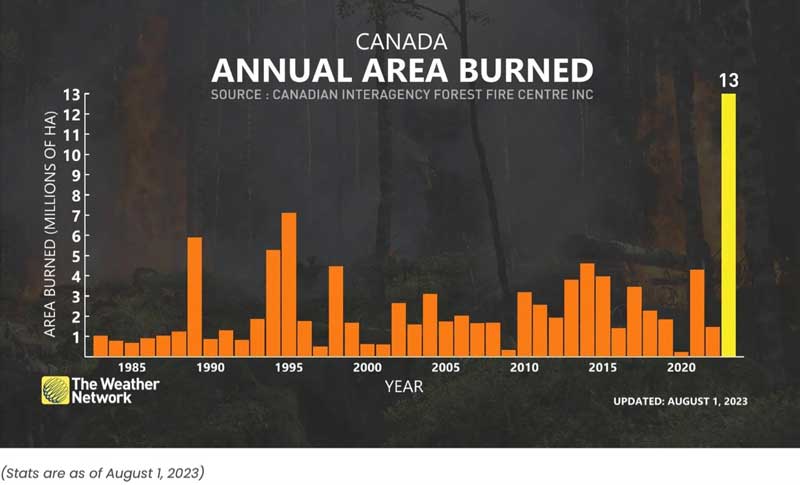
It’s a record fire year in Canada and in much of the northern hemisphere, along with heatwaves, drastic storms, is this the new normal. Far from it says wildfire scientist Mike Flannigan from Thompson Rivers University in Kamloops. George Chandler tells us how a group of volunteers are opening up Baker Street on Sunday August 20 for a TownHall Square. Scott Onyshak speaks to Cathy Fielder, the Director of Fisheries at the Creston Valley Rod and Gun Club about restocking Kokanee in Kootenay Lake.
ENVIRONMENT NEWS
The province of British Columbia spent $1.65 million killing wolves and cougars in the first few months of 2023. In total, 217 wolves and 8 cougars were killed. This is according the new information posted on the province’s caribou recovery program website. The 2022-2023 pdf summary details the province’s activities during last winter’s wolf cull, a taxpayer-funded program that kills hundreds of wolves in British Columbia every year.
The 217 wolves were tracked and shot from helicopters, while hunting dogs were used to track the eight cougars that were killed. The annual wolf cull is one method the province has adopted to address endangered caribou declines. However, research has shown that killing wolves won’t save caribou. These animals are being needlessly killed by government contractors year after year, while caribou habitat is being destroyed and disturbed by human activity
___________________________________
Falling deforestation rates in countries including Indonesia, Malaysia, Colombia and Brazil could provide a boost to climate and biodiversity efforts, experts say, in the run-up to a key summit on the future of the Amazon rainforest.
In the coming days, the Brazilian president, Luiz Inácio Lula da Silva, will host a pan-Amazonian summit on the future of the world’s largest rainforest, with leaders from Venezuela to Peru hoping to present a plan at Cop28 to halt their destruction. Experts have said if rich countries provide backing to tropical forested countries it could help governments deliver on Cop26 promises to halt and reverse deforestation by 2030.
___________________________________
Climate change is driving up insurance rates and raising questions about whether private coverage will even be available for some Canadians in the future.
The problem could mean the National Flood Insurance Program that Canada is developing to ensure access to affordable overland flood coverage might soon have to be expanded to wildfires, wind storms, and hurricanes, The Canadian Press reports.
Statistics Canada’s latest inflation report showed home insurance costs were up 8.2% nationally in June, compared with one year earlier. Increases were about 10% in Alberta, British Columbia, and Saskatchewan, and nearly 12% in Nova Scotia.
___________________________________
The fearsome heatwaves that seared western North America, southern Europe, and China in July would have been “virtually impossible” without climate change, a new study has found.
Analysis by the World Weather Attribution initiative (WWA) revealed that the furnace-like lethal heat spanning 18 days in parts of the United States and Mexico, 14 days in the lowlands of China, and one week in southern Europe “would have almost no chance of happening in a world without climate change,” reports the Washington Post.
___________________________________
Four years after Montreal decided to make a 2.5-kilometre stretch of a busy downtown artery car-free every summer, the transformation continues to get rave reviews from users and local businesses.
Covering more than 30 intersections, the stretch of Mont-Royal Avenue currently given over to pedestrian traffic has been turned into “a daily festival” by Montrealers and out-of-towners, “with thick crowds almost around the clock, shopping, wandering, packing private patios, or sinking into the baby-blue Adirondack chairs laid out for public use,” writes the Globe and Mail.
Mont-Royal remains the flagship effort, but no less than nine other commercial streets in Montreal are being similarly transformed this summer. “The spectacle of one major street without cars, let alone 10, has left certain visitors from the rest of Canada marvelling at Montreal’s ambition,” writes the Globe.
___________________________________
A small subset of predominantly foreign, corporate owners hold substantial control over Canada’s oil and gas industry, and are unlikely to push for carbon cuts unless mandated to do so, a new study concludes.
That means it’s up to Canadian policy-makers to introduce new rules that compel big investors to actively support the low-carbon transition, say the authors of the study, A voice for change? Capital markets as a key leverage point in Canada’s fossil fuel industry
“A few large shareholders stand to gain substantially through monetizing the destruction of the world’s climate and will continue to engage with the industry in a manner that contradicts effective climate solutions,” the researchers write. “However, capital can also be used to reshape society if the power is regulated accordingly by financial supervisors.”
So far, the Canadian government has been a “leader and a laggard” in the transition to a low-carbon economy, say the authors. Despite ambitious emissions targets, they maintain, Ottawa continues to allow—and support—oil and gas production and expansion.
___________________________________
Back on July 24. FRACK FREE had a BC Wide day iof action in front of MLA offices. A giant mural went up in front of Environment Mininster George Heyman’s office in Vajcouver The mural says “END FRACKING” and “protect our communities from climate disasters” in giant letters. Frack Free BC volunteer teams held actions in Point Grey, Victoria, Surrey, Nelson, Vernon, Powell River, Davis Bay, Squamish and Richmond. They hosted rallies to “Turn Up The Heat” on their MLAs! Here’s a video featuring everyone in action.
___________________________________
 Longest running Enviro News show on the Radio!