

LISTEN OR DOWNLOAD APRIL 5 SHOW HERE:
At the March 25 Fridays for Future climate strike in Nelson there was lots of talk about climate and preserving old growth. One of the speakers was Nelson ecologist Rachel Holt who tied climate and forest conservation tightly together. We have some of her talk at the rally.
On April 4th the International Panel on Climate Change, the IPCC, released the third segment of this year’s major report. This year’s is likely the last report from the IPCC that has any chance of preventing climate catastrophe. The reports take years to research and prepare… and by the time of the next one, it may be too late. Eddie Perez from the ClimateActionnetwork.ca talks to us about the good news from the report about progress on avoiding climate catastrophe.
The Kootenay Carshare Coop promotes electric vehicles in new video, and people are getting on board.
LINKS AND EVENTS
The IPCC 3rd Working Group Report
FEATURED
‘Terrifying’ IPCC Report Chronicles ‘Fast Track to Climate Disaster’, Shows Narrowed Path to 1.5°C April 4, 2022
____________________________________
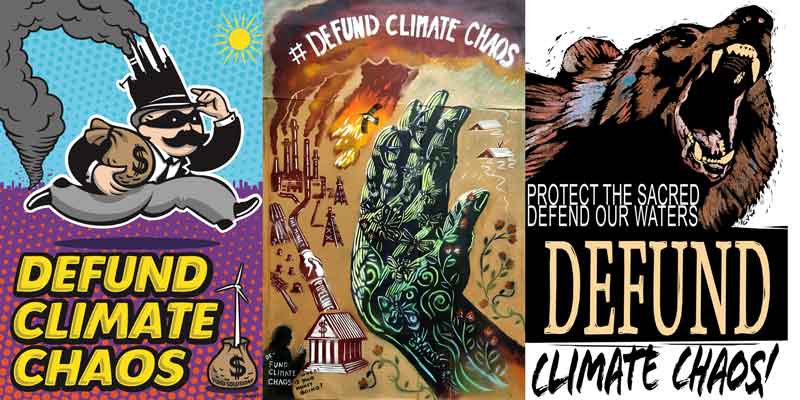
#DefundClimateChaos
Massive Poster event just part of global action to stop funding fossil fuel expansion.
https://docs.google.com/document/d/1gRIypQ4IZbwR0cOcvJ93gefOYZSvXlZQez6TK__pCR0/edit
____________________________________
Wednesday April 13th, 4pm
The West Coast Climate Action Network is hosting the 2nd of four webinars on Transportation in a Time of Climate Crisis. This one is about the need for active Transportation.
The guest speakers are
• Trish Dehnel, community planner, active with the Castlegar-Nelson Active Transportation Corridor Team;
• Iona Bonamis, Senior transportation planner;
• Thomas Thivener, Active Transportation Lead with Watt Consulting.
• Our MC is Mona Dahir, Road Safety EIT with the City of Surrey.
Register here: https://www.eventbrite.ca/e/294167532007
The West Coast Climate Action Network is also launching a public petition calling on the BC Government to establish a plan to achieve BC’s 2030 active transportation mode share targets, and to increase the provincial Active Transportation program funding from $20 million to $100 million annually, and the maximum for a project from $500,000 to $5 million, by re-allocating funds from highway expansion projects.
_________________________________
April 22 – 29 Global Week of Advocacy for a Fossil Fuel Treaty
Join the Global Week of Advocacy and receive action alerts on how you can help take the proposal for a Fossil Fuel Treaty to key ministers in Canada, as well as directly to the United Nations. After pledging to join, we’ll be in touch with a number of actions and updates of how you can join this huge global campaign. https://fossilfueltreaty.good.do/act/join/
Wednesday April 13th, 4pm
The West Coast Climate Action Network is hosting the 2nd of four webinars on Transportation in a Time of Climate Crisis. This one is about the need for active Transportation.
The guest speakers are
• Trish Dehnel, community planner, active with the Castlegar-Nelson Active Transportation Corridor Team;
• Iona Bonamis, Senior transportation planner;
• Thomas Thivener, Active Transportation Lead with Watt Consulting.
• Our MC is Mona Dahir, Road Safety EIT with the City of Surrey.
Register here: https://www.eventbrite.ca/e/294167532007
The West Coast Climate Action Network is also launching a public petition calling on the BC Government to establish a plan to achieve BC’s 2030 active transportation mode share targets, and to increase the provincial Active Transportation program funding from $20 million to $100 million annually, and the maximum for a project from $500,000 to $5 million, by re-allocating funds from highway expansion projects.
_________________________________
April 22 – 29 Global Week of Advocacy for a Fossil Fuel Treaty
Join the Global Week of Advocacy and receive action alerts on how you can help take the proposal for a Fossil Fuel Treaty to key ministers in Canada, as well as directly to the United Nations. After pledging to join, we’ll be in touch with a number of actions and updates of how you can join this huge global campaign. https://fossilfueltreaty.good.do/act/join/
ENVIRONMENT NEWS
Last week on the closing day of the BC Teachers Federation AGM, members voted to divest from fossil fuels. Teachers of B.C. came out in a strong majority to support a motion that will see a move away from these destructive companies that drive climate chaos. This is a huge win for the environment, and a move for the teachers of BC that aligns with our principles of environmental stewardship and Reconciliation with Indigenous peoples. #bctf2022 #bctfdivestnow
______________________________
A public outcry is growing against a proposed BC Timber Sales Pest Management Plan to use aerial and ground spraying of herbicides to increase commercial lumber output.
The proposed management plan would come into effect on April 1, 2022, and cover the Chilliwack and Sea to Sky Natural Resources District, including the traditional unceded territories of the Stó:lō, (Musqueam),(Squamish), and Tsleil-Waututh First Nations. The proposed plan is for five years, ending in 2027.
While the notice was printed in the local newspaper in Hope, along with the draft proposal available online, it does not include a map of specified locations where herbicides such as glyphosate, triclopyr and 2,4-D (Formula 40) will be used.
______________________________2
A New-York-City-sized ice shelf has collapsed in East Antarctica, much to the alarm of scientists who thought the region was substantially protected from the impacts of climate change, unlike the more vulnerable western reaches of the continent.
Captured on satellite images, the collapse of the 1,200-square-kilometre Glenzer Conger ice shelf happened at the start of “a freakish warm spell” last week, when temperatures in some parts of East Antarctica soared more than 40°C warmer than normal, reports the Associated Press.
The mercury rose to a balmy -11.8°C, the Guardian reports, attributing the spike to an atmospheric river trapping heat over the entire continent.
__________________________
Three in five Canadians say that it’s time to buy an electric vehicle and more than half say they “will never buy a gas-powered vehicle again,” according to a new poll by KPMG in Canada. With gas prices shooting up, almost a third regret not having bought an EV already.
“The poll results show that rising fuel prices are a big catalyst in changing Canadian attitudes towards EVs,” says Peter Hatges, National Automotive Sector Leader, KPMG in Canada.
___________________________
Fossil investment from the world’s 60 biggest banks hit US$4.6 trillion in the six years since the Paris climate agreement was signed, while the Royal Bank of Canada and TD Bank led a 51% increase in tar sands/oil sands investment last year, according to the latest edition of the annual Banking on Climate Chaos report released last week.
“In 2021, the year of ‘net zero by 2050’ pledges, banks prematurely patted themselves on the back for adopting financed emissions targets a generation away while delaying serious climate action now,” concludes the analysis compiled by Rainforest Action Network, BankTrack, the Indigenous Environmental Network, Oil Change International, Reclaim Finance, the U.S. Sierra Club, and Urgewald. Overall fossil investment plateaued in 2021, but that still meant $742 billion in fossil investment in a single year. At the same time the Intergovernmental Panel on Climate Change, the International Energy Agency, and countless others say we must drastically scale back investment and development of fossil fuels of all kinds.
___________________________________
Last year the provincial government gave away $1.2 billion in a single fossil fuel subsidy known as the Deep Well Royalty Credit, a tax credit for hydraulic fracturing wells, according to new analysis by Stand.earth.
This takes the lion’s share of the possible $1.9 billion that fossil fuel companies saved thanks to various subsidies over the same time period, calculates the environmental advocacy group.
This week’s analysis applied the World Trade Organization’s definition of a fossil fuel subsidy to the 2022 provincial budget to crunch these numbers, said Sven Biggs, Canadian oil and gas program director with Stand.earth. A simplified version of the definition is “any government funding that either goes to the production of fossil fuels or helps reduce the cost of purchasing them,” he said.
The Deep Well Royalty Credit has amassed $3.4 billion in credits, which means future governments will miss out on billions in royalty revenue on natural gas, he said. Cancelling credits and phasing out subsidies means the oil and gas industry would not be financially viable and would wind down the industry — giving B.C. a shot at actually hitting its 2030 climate goals, he added.
https://thetyee.ca/News/2022/03/25/One-BC-Fossil-Fuel-Subsidy-Reached-One-Billion-Last-Year/
____________________________
The West Moberly First Nations was headed to court this spring, seeking to halt Site C because the dam violates its treaty rights and threatens its traditional territory along the Peace River in northeastern B.C.
But the treaty infringement claim has been adjourned. Instead BC Hydro and West Moberly First Nation “are continuing confidential discussions to settle this litigation,” Hydro reported this week.
Columnist Vaughn Palmer reports in the Vancouver Sun that West Moberly won a preliminary round last year, when the court granted access to confidential material regarding the safety and risks of Site C.
Included in the order was the full report of Peter Milburn, who was brought in to review Site C after a geotechnical instability was detected in the foundations for the generating station, spillway and the earth fill dam itself.
There is much speculation that BC Hydro made some lucrative offer to negotiate instead of going to court, because the court hearings could make public some of the crucial information about the dam’s costs and viability.
____________________________
 Longest running Enviro News show on the Radio!