
LISTEN OR DOWNLOAD THE SHOW HERE:
The EcoCentric for World Water Day March 22nd.
The new world price for gasoline is a harsh shock for British Columbians who commute. Big oil corporations are hauling in a windfall of profits. Economist Marc Lee at the Canadian Centre for Policy Alternatives in BC says tax the excessive profits with a windfall tax.
Last year Parliament in Ottawa passed the Net Zero Emissions Accountability Act which set March 31 as the deadline for the government to set in place concrete plans to meet our emission reduction targets.
Caroline Brouillette, the national policy manager for the Canadian Climate Action Network, tells us what they are looking for in the government’s plan.
Howard Breen, a Vancouver Island activist is launching a hunger strike for Old Growth and Climate Action.
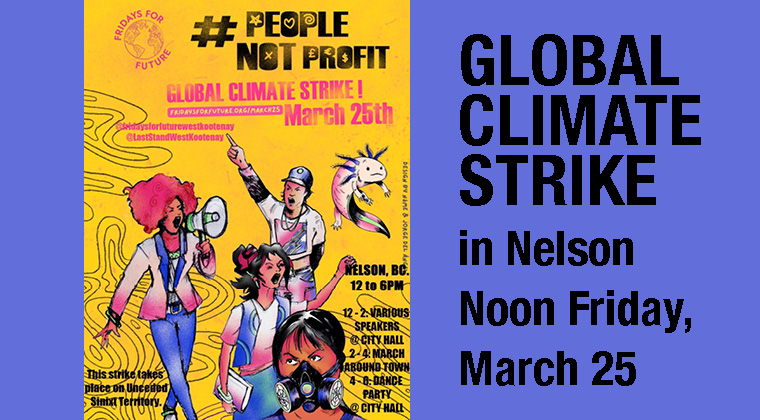
Miguel Pastor on Fridays for Future Climate Strike coming up Friday March 25th.
LINKS AND EVENTS
Tax windfall oil profits
Federal emission reduction plan coming
Climate Action Network
Howard Breen Launches hunger strike
Fridays for Future West Kootenay.org
Nelson-Creston Greens webinar for World Water Day March 22nd
7 pm
Watershed Sentinel webinar on accessing National Pollution Inventory 12:30 pm Wednesday March 23
Environment News and links
Startling heatwaves at both the North Pole and the South Pole are causing alarm among climate scientists, who have warned the “unprecedented” events could signal faster and abrupt climate breakdown.
Temperatures in Antarctica reached record levels last week, 40 degrees C above normal in places.
At the same time, weather stations near the north pole also showed signs of melting, with some temperatures 30C above normal.
At this time of year, the Antarctic should be rapidly cooling after its summer, and the Arctic only slowly emerging from its winter, as days lengthen. For both poles to show such heating at once is unprecedented.
The rapid rise in temperatures at the poles is a warning of disruption in Earth’s climate systems. Last year, in the first chapter of a comprehensive review of climate science, the Intergovernmental Panel on Climate Change warned of unprecedented warming signals already occurring, resulting in some changes – such as polar melt – that could rapidly become irreversible.
theguardian.com/environment/2022/mar/20/heatwaves-at-both-of-earth-poles-alarm-climate-scientists
________________________________________
The main Kootenay Lake kokanee fish population has “collapsed” but it is in no danger of disappearing, according to the province’s latest update on the state of the lake’s keystone species.
Speaking after a Kootenay Lake public meeting on March 14, a spokesperson for the Ministry of Forests, Lands, Natural Resource Operations and Rural Development said the collapse started from 2012 to 2015 and the kokanee spawning return is now about three per cent of the long-term historic average.
High populations of Gerrard rainbow and bull trout are the major cause of the populatioin drop and government scientists said the kokanee are currently mired in a “predator pit.”
“Historically, these fish became very large when kokanee were abundant,” he explained. But the large trout predators in Kootenay Lake survive well for at least the first few years of life but are now small and skinny.”
___________________________________________________________
In November, a UN-backed team of researchers found that the world was on track to produce 70% more natural gas in 2030 than would be compatible with the 1.5C goal, reports the Reuters news agency.
Climate scientists say that rising production of natural gas is emerging as one of the biggest drivers of climate change, and that plans for industry expansion could hobble efforts to stabilize the Earth’s climate.
Much of that fossil gas expansion is billions of dollars building pipelines and terminals to increase exports of natural gas in supercooled liquefied form, LNG. The huge LNG Canada project being built in Kitimat, BC is one of them.
Emissions globally need to fall by about 7.6% a year between now and 2030 to meet the 1.5C target, according to the U.N. Environment Programme.
But emissions from the natural gas industry, particularly in the United States, and Canada are now growing so rapidly that the sector “is quickly becoming one of the biggest, if not the biggest, challenges to address climate change,” said Pep Canadell, a senior research scientist at CSIRO Climate Science Centre in Canberra, Australia.
https://www.reuters.com/article/us-usa-gas-climatebox-explainer-idUSKCN25E1DR
_______________________________________
Residue from vehicle tires contains a chemical highly toxic to several important species of fish when it washes into streams, says new Canadian research.
“It seems almost like the fish are suffocating from the inside,” said University of Saskatchewan toxicologist Markus Brinkmann. “It’s not the nicest thing to observe.”
Brinkmann’s research has added to a growing body of research looking into the effect of tire residue when it enters the environment.
A link between fish fatalities and such residue was first revealed in a 2021 paper that examined deaths of coho salmon in Washington state in streams subject to heavy rainfall runoff from urban areas. That paper concluded the kills were due to a chemical called 6PPD-quinone, a contaminant formed from the residue tires leave on roads as they wear.
Brinkmann found the same effects on rainbow and brook trout, two culturally and economically important fish widespread in North America.
The chemical seems to inhibit breathing, he said.
________________________________________
A new federal Clean Fuel Standard (CFS) should be a market driver for non-fossil fuels but if it goes ahead as proposed it will turn into a subsidy for the fossil fuel sector, says an analysis in the National Observer.
They point out that BC has adopted a simple, cost-effective regulation called the Low-Carbon Fuel Standard. In the last 18 months, over a half-billion dollars of new investment, accompanied by family-supporting cleantech jobs, have poured into new clean fuel production and distribution across B.C.
But Canada’s regulation, almost six years in the making, virtually ensures that fossil fuels, not low-carbon alternatives, will be the single biggest beneficiary. To meet their Clean Fuel Standard obligations, fossil fuel producers can double-count actions already taken in response to other policies, including industrial and consumer carbon prices.
In the 2021 federal election, there was support for much better standards across the political spectrum, including the adoption of a B.C.-style low-carbon fuel regulation in the Conservative Party of Canada’s platform.
________________________________________
Last week, Innovation, Science and Industry Minister François-Philippe Champagne announced a $27.2-million investment in the development of nuclear technology he said will make energy more accessible to remote communities.
However, numerous Indigenous, scientific, environmental and citizen groups have called the technology a “dirty, dangerous distraction” from real climate action.
The money will go to the development of Westinghouse Electric Canada Inc.’s eVinci micro-reactor, a small modular reactor (SMR) the company says will “bring carbon-free, transportable, safe and scalable energy anywhere Canada requires reliable, clean energy.”
But M.V. Ramana, professor at the School of Public Policy and Global Affairs at the University of British Columbia, have found SMRs aren’t a practical solution when compared to renewable sources of energy, such as wind and solar.
“There is no viable market for small modular reactors, and even building factories to manufacture these reactors would not be a sound financial investment,” Ramana said.
There’s also criticism around the nuclear waste SMRs would produce.
Opposition to SMRs has already come from many groups including the Assembly of First Nation Chiefs, which passed a resolution in 2018 urging the abandonment of SMR plans and funding.
SMRs are still in the development stage, and any potential benefits they might have in slashing greenhouse gas emissions would not arrive for many years, too late to meet global climate targets.
________________________________________
There’s still time for decisive actions that would stabilize global temperatures over a span of three or four years, rather than three or four decades, two senior climate scientists said, during a recent webinar hosted by the Covering Climate Now (CCNow) news collaborative.
“Tontrary to long-held assumptions, large amounts of temperature rise are not necessarily locked into the Earth’s climate system,” said CCNow co-founder and executive director Mark Hertsgaard. “As soon as emissions are cut to zero, temperature rise can stop in as little as three years. Three years, not the 30 to 40 years that almost all of us as journalists thought was the scientific consensus.”
That means humanity “can still limit temperature rise to the 1.5°C target,” Hertsgaard added, “but only if we take strong action now.”
________________________________________
Business leaders from the United States and Canada are again wading into the fray over Line 5, citing the energy crisis brought on by Russia’s war in Ukraine to accuse the state of Michigan of dragging its heels to keep the controversial cross-border pipeline in a state of legal limbo.
In a new joint amicus, or “friend of the court” brief, the Canadian Chamber of Commerce, its U.S. counterpart, and chambers in Michigan, Ohio, Pennsylvania, and Wisconsin reiterate their concern that shutting down the Enbridge Inc. pipeline would have “tremendous negative consequences” on both sides of the border, The Canadian Press reports.
But Michigan Attorney General Dana Nessel is weighing in with concerns of her own, contending last week that corporate “propaganda” is driving public support for Line 5.
The dispute over Enbridge’s Line 5 has been raging since November 2020, when Governor Gretchen Whitmer—citing the risk of a spill in the ecologically sensitive Straits of Mackinac, where the line crosses the Great Lakes—abruptly revoked the easement that had allowed it to operate since 1953.
 Longest running Enviro News show on the Radio!