
NOV 23 EPISODE. LISTEN OR DOWNLOAD HERE:
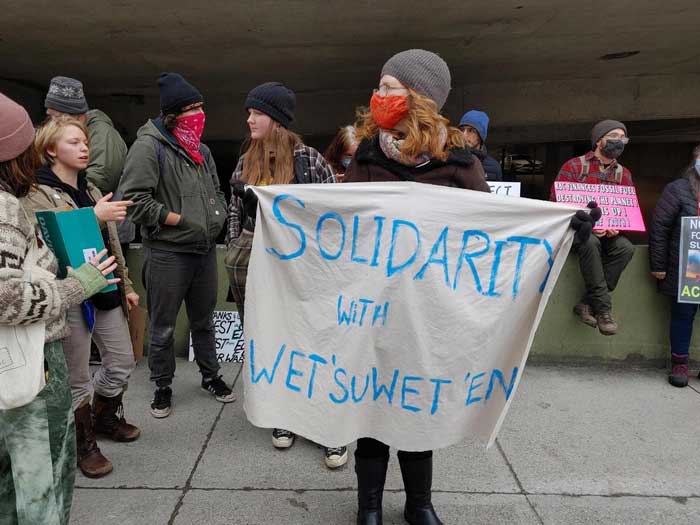
Climate disaster hit again and BC is going to be digging out for a long time yet. We talk with University of BC Professor Dr. Simon Donner about the climate context for these catastrophes. The RCMP moved in and arrested some 30 people from Wet’suwet’en Territory on the weekend, including three journalists. In Nelson a vocal group held a protest in support, we hear some local voices. The EV revolution is here says the National Geographic… Not so fast says John Pattison from Silverton, Oregon and the Strong Towns movement.
LINKS:
EVENTS:
Seth Klein – A Good War: Mobilizing Canada for the Climate Emergency
Tuesday November 30, 7pm PT
The Mir Centre for Peace presents Seth Klein, activist and author as he explores how to align politics and the economy with the need to address the climate crisis. Virtual event.
Get tickets here: https://www.eventbrite.ca/e/seth-klein-a-good-war-mobilizing-canada-for-the-climate-emergency-tickets-203233776697
ENVIRONMENT NEWS AND EVENTS:
ou have of course heard there is gas rationing going on in the lower mainland. But you may not know that one of the reasons for the shortage is the shutdown of the TransMountain pipeline, badly damaged by flooding and slides.
One engineer reported that the “pipe, usually buried in a thick blanket of soil and rock, was bare and moving up and down in the river “like a piece of cooked spaghetti.”
On the other side of the river was another danger. Enbridge’s Westcoast gas pipeline also had escaped its casing, leaving it at the mercy of rushing water.
So far, neither company has reported a leak, but Trans Mountain confirmed in a statement yesterday that the pipeline has sustained damage.
https://thetyee.ca/News/2021/11/23/When-Surging-Floods-Meet-Expanding-Pipeline/
_____________________________________
This year, for the first time, negotiators from 179 countries finally agreed to put the words “fossil fuel subsidies” and “coal” directly in the text of the agreement. But Stand.Earth’s Tzephorah Berman says “Our work is far from over – the mentions are still nowhere near the level of ambition we need to tackle the global climate crisis. But I see this moment as a tipping point when the world finally starts to talk about how to constrain the production of fossil fuels.”
She goes on: Our work to protect old growth forests, transform massive industries like fashion to shipping and create a Global Fossil Fuel Non-Proliferation Treaty struck a chord with people gathered at COP.
There were several big announcements that our work directly contributed to, and while I could also talk for hours about how none of them go far enough.
____________________
A promise to develop a North American strategy on methane and black carbon emissions didn’t make headlines but it was part of the three amigos meeting between Prime Minister Justin Trudeau, U.S. President Joe Biden, and Mexican President Andrés Manuel López Obrador.
The White House statement says they plan “to reduce methane emissions from all sectors, especially oil and gas,”. “We will also focus on reducing black carbon from diesel vehicles and engines, flaring, wood-burning appliances, and shipping.”
Canada and the US also recommitted to the Global Methane Pledge,” the statement added
____________________
Canadian scientists, journalists and members ave much in common when it comes to their beliefs about the causes and impacts of climate change. That’s according to a new study released this weeik.
But the study from the University of Victoria says there are big differebnces in how the three groups think hw the media should do the important job of translating the latest climate science for a public audience”
Sean Holman, who’s the Wayne Crookes professor of environmental and climate journalism at the University of Victoria says:
“What interested me was just how much scientists want to be included in climate change coverage and want to communicate more directly with the public about climate change,” said Holman.
__________________________
Guy Dauncey, the Practical Utopian and one of BCs foremost environmental and climate action leaders has published a visionary story about a green future. Set in a future Hawai’i some one hundred years from now, it describes a new, better and more peaceful world. Not one without climate problems, but a community and society at peace with nature and the planet.
It’s available on line to read and download for free. Check out Guy Dauncey’s website: ThePracticalUtopian.ca
The EcoCentric’s travelling co host Linn Murray filed his overall report on visiting Glasgow for the COP 26 climate summit. Linn says that
“While filled with progressive language, it fails to meet the bare minimum thresholds for curtailing global warming to either 1.5C or 2.0C this century. International climate policy remains all talk and little walk.”
You can read his full report on the wildsight,.ca website.
Experts have long cautioned that clearcut logging affects slope stability, the rate at which water is absorbed into the ground and the ability to hold soil in root systems. Without trees, heavy rains can wash large amounts of sediment into nearby water systems, choking creeks and streams and causing them to quickly overflow.
“Over the last couple days, I’ve been looking at the areas that have been particularly hard hit, and it happens to coincide with some of the communities that have been logged the heaviest,” said Wood. “A lot of that is due to the mountain pine beetle, but nonetheless, the cutting really does affect the amount of water that flows overland.”
said Thomas Martin, a forester in the province. “If you burn a lot of the trees, grass and shrubs, there are fewer living things to intercept the water. It just flows directly off the hill. And fires can make the soil hydrophobic so the runoff increases even more.”
At the same time, British Columbia has suffered some of its worst wildfire seasons in recent years. As the aftermath of the storm became clear, a number of the areas worst hit were also near blazes that tore through the province earlier in the summer.
Martin says forest ecologists have long recommended controlled burns as well as selective logging to thin the forests, allowing larger mature trees to thrive and improving protection against wildfires.
https://www.theguardian.com/world/2021/nov/16/canada-floods-fires-logging-british-columbia
_______________________________________
A severe rainstorm is beginning to move over southwestern Newfoundland, in what meteorologists are predicting will be an “unprecedented” weather event.
“For me, this is my first time seeing a rainstorm like this. It’s almost eerily similar to kind of what happened to B.C. just a few weeks ago, with the atmospheric river just pumping lots of moisture into the air,” said Veronica Sullivan of Environment Canada’s weather office in Gander.
“I don’t think we’ll see as bad an impact here as what happened in B.C., but still it’s going to be something to watch and it’s going to break a lot of weather records.”
https://www.cbc.ca/news/canada/newfoundland-labrador/newfoundland-rain-storm-1.6259208
 Longest running Enviro News show on the Radio!