
On the show today, we are talking about the federal election which sure didn’t change much. We have Mitchell Beer in Ottawa from theEnergyMix.com to comment on it. Friday, September 23 there is another youth-lead global strike. Jamie Hunter from Nelson tells us about it. A whole climate action network is emerging in BC and we have Tracey Saxby from the Sea to Sky to talk about a push in the next few days to get the BC government to really up our climate game.
LISTEN TO THE FULL EPISODE HERE:
SOME LINKS:
TheEnergyMix.com. A great compendium of environment, climate and energy news.
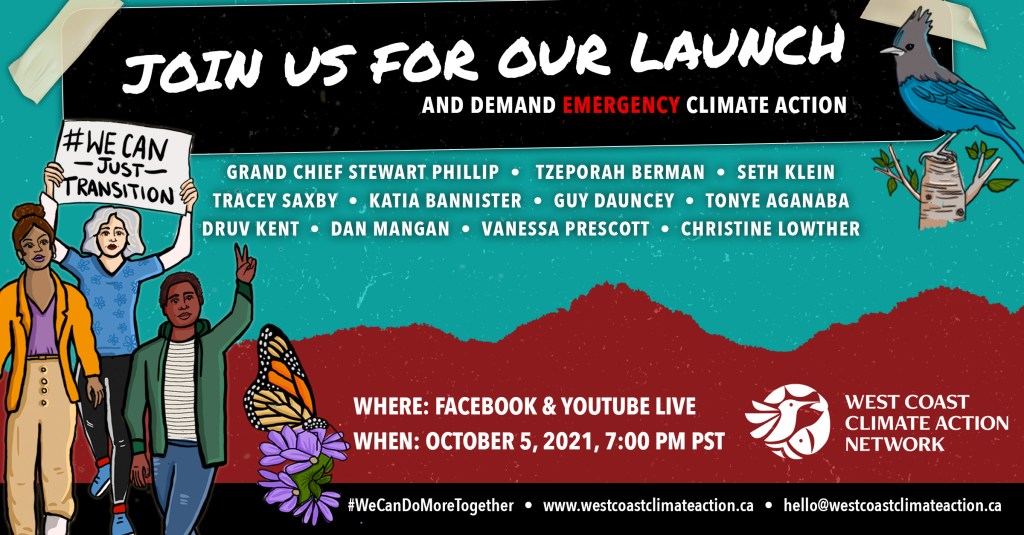
WestCoastClimateAction.ca. Connecting all the climate news, strategies, groups and actions in BC.
Fridays for Future West Kootenays.org Local organization of the youth global climate movement.
THE ENVIRONMENT NEWS FOR SEPT 21, 2021
Teck Resources Ltd. could sell its huge coal mining operations in southern BC. A recent financial Post report says Teck is exploring options for its metallurgical coal business, including a sale or spinoff that could value the unit at as much as US$8 billion.
it studies strategic alternatives for the business, which is one of the world’s largest exporters of the steelmaking ingredient.
Exiting coal could free up resources for Teck to accelerate its plans in commodities like copper, as demand shifts to the building blocks of an electrified global economy. Deliberations are at an early stage, and Teck could still decide to keep the business, the report said.
__________
Community organizations opposed to the construction of a massive aboveground radioactive waste dump near the Ottawa River are finding support among some federal electoral candidates.The groups asked candidates in the 2021 federal election in 13 ridings in West Quebec, Eastern Ontario and Ottawa if they would initiate a regional assessment under the federal Impact Assessment Act to look into radioactive waste, nuclear decommissioning and the remediation of contaminated lands in the Ottawa Valley. Seven candidates from the NDP and Green Party and one Independent agreed to push for a regional assessment.
In May 2021, the City of Ottawa wrote to federal Environment Minister Jonathan Wilkinson asking for a regional assessment on nuclear waste in the Ottawa Valley, but the minister declined the request.
NDP candidate Denise Giroux pledged to work tirelessly to oppose these “irresponsible” waste management plans and added she would “refuse to stand idly by, as the former MP did, while these projects forge ahead. Nearly 40 Indigenous groups, along with 6 million people downstream from these projects. . .have tried to voice their opposition to these plans.”
__________
The Reserve Bank of Australia says the coming collapse in coal shipments as Australia’s biggest customers pivot to net zero would impose only a relatively modest hit on economic growth.
Officials at the bank said in a research paper published on Thursday coal exports and, to some extent, gas shipments could plunge by as much as 80 per cent if China, Japan and South Korea take an aggressive approach to decarbonising their economies by mid-century.
__________
Enbridge will have a tougher time finding insurance for its controversial Line 3 pipeline as insurers increasingly limit coverage of oil and pipeline projects — particularly those tied to Canada.
Thats what Enbridge said last week in filings with the Minnesota Public Utilities Commission (PUC). The Calgary, Alberta-based company reported that it has the coverage required by the PUC.
But the insurance market has an increasing aversion to oil projects due to carbon emission concerns and the low profitability of insurers hit by pollution-related losses, according to a report done for Enbridge by Marsh, one the world’s largest insurance brokerages.
__________
The world’s largest publicly traded property and casualty insurer, CHUBB has announced that
it does not provide insurance coverage for any tar sands projects.
A report in the Financial Times says this in includes stopping insurance for the TransMountain pipeline expanison.
“By dropping Trans Mountain, Chubb has started to walk the talk around the climate crisis.” said Charlene Aleck of the Tsleil-Waututh Nation Sacred Trust Initiative. The Trans Mountain Pipeline and expansion is a fuse to the carbon time bomb known as the Alberta Oil Sands that violates Tsleil-Waututh Nation’s inherent and constitutionally protected rights.
We are committed to stopping this destructive and risky project on behalf of the salmon, the orcas and for future generations of people who live in our territory,” Charlene Aleck said.
http://priceofoil.org/2021/09/14/insurance-campaign-chubb-tar-sands-exit/
__________
California’s terrible fire calamity continues with giant fires showing new climate sensitive behaviours. This week the Caldor fire threatened to level the resort town of South Lake Tahoe,. It is a massive fire that p burning from one side of the Sierra to the other.
It seared through crests and valleys, over foothills and ridges — and also at elevations of 8,000 feet or higher.
Ash and smoke rained down on the Tahoe basin and sent thousands fleeing from its soot-darkened shores as the fire skirted a towering granite ridge many believed would be a buffer from the flames. But the fire kept climbing higher, jumping from tree to tree and spewing wind-whipped embers that landed, in some cases, more than a mile away.
Experts said the fire’s extreme behavior is part of a worrisome trend driven by the state’s warming climate, in which rapid snowmelt and critical dryness are propelling wildfires to ever-higher elevations, scorching terrain that previously was too wet to burn and threatening countless residents.
__________
This month the UN’s Food and Agriculture Organizatioin launched two global resources on the climate crisis.
1 A global map shows how much and where CO2 can be sequestered by soils.
2 A technical manual of good practices set to sequester and maintain soil organic carbon stocks in soils (Volume 1–Volume 6).
In particular, peatlands also called organic soils, bogs, fens, swamps, or mires are identified as hotspots in Volume 2. This means that they are very sensitive to climate change and can easily become sources of greenhouse gas emissions due to their high soil organic carbon content.
Fossil fuel companies are suing governments across the world for more than $18bn (£13bn) after action against climate change has threatened their profits,
Canada based TC Energy, the company behind the controversial Keystone XL pipeline, is suing the US government for $15bn (£10.9bn) after the Biden administration cancelled the project, citing the fight against climate change.
Meanwhile German companies RWE and Uniper are suing the Dutch government for $1.6bn (£1.16bn) and $1.06bn (£768m) each following the Dutch government’s move to phase out coal and shut down coal-fired power plants by 2030.
“Fossil fuel companies should be paying to fix the climate crisis they caused, but instead they want a payout.
“They’re suing governments who take climate action through secretive corporate courts, massively increasing the cost of climate action”.
She added: “These courts are built into trade deals and operate outside of and supersede domestic courts and legal systems.
__________
 Longest running Enviro News show on the Radio!