
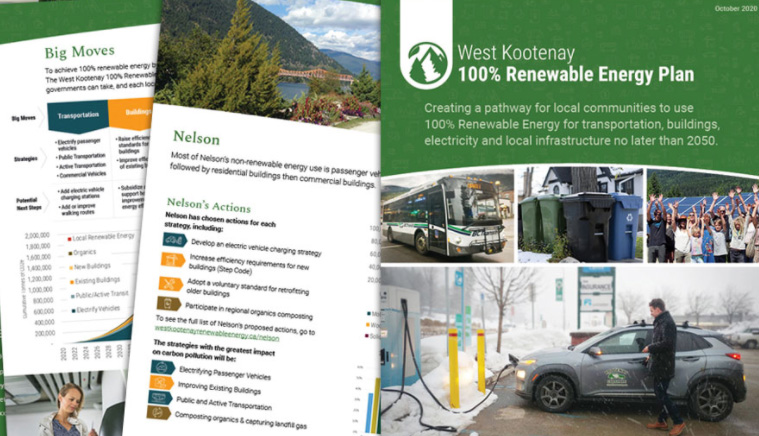
Last week the West Kootenay EcoSociety and its community partners released the draft West Kootenay 100% renewable energy plan. We spoke with the EcoSociety’s David Reid about it and found out how each one of us can get involved.
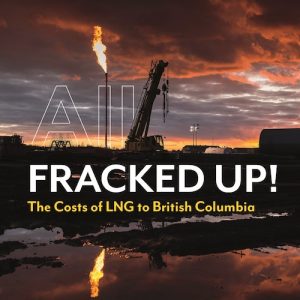
LNG, fracking and pipelines were of course one of the big discussion points in the election… but not all the details come out in debates. A new book published by the Watershed Sentinel offers some compelling insight on LNG questions. To find out more we spoke with one of the book’s editors, Alice De Wolff.
And a great clip from the melliflous voice of David Attenborough. His newest movie, now on Netflix, is her personal witness of the planet, what he’s seen happen to it… and his hope for a way forward. Very moving.
Download or listen to the full show here:
Environment News for the week of Oct. 27 2020
Last week Alberta energy company, TransAlta Renewables announced a new 10 MW WindCharger battery storage project has begun commercial operation. WindCharger is Alberta’s first utility-scale, lithium-ion energy storage project and utilizes Tesla Megapack technology.
The entire infrastructure can be fully charged in around two hours, TransAlta said. The Megapacks will be powered through the Summerview II wind farm, creating a fully-renewable energy project that relies on zero fossil fuel sources.
The Tesla batteries have enough power to provide 90 minutes of electricity use for all residents of the town Pincher Creek, for example.
________________________________________
For the first time since records began, the starting freezing point for Arctic sea ice in Siberia has yet to start freezing by late October.
Extreme warm weather in northern Russia and the inflow of warmer Atlantic waters, are holding off the freeze, say climate scientists who say there will be effects across the polar region.
Ocean temperatures in the area recently climbed to more than 5C above average, following a record breaking heatwave and the unusually early decline of last winter’s sea ice.
Scientists say without a systematic reduction in greenhouse gases, the likelihood of our first ‘ice-free’ summer will continue to increase by the mid-21st century.
________________________________________
Electric cars will cost the same to make as internal combustion engine cars by 2024, according to new research.
The extra cost of manufacturing battery electric cars will fall to just $1,900 per car by 2022, and disappear completely by 2024, according to research by the investment bank UBS.
When electric vehicles have the same sticker price as fossil fueled ones, it will be a major truning point in the transition away from burning fossil fuels.
The costly batteries, which are almost exclusively made by east Asian companies,. account for between a quarter and two-fifths of the cost of the entire vehicle. The research showed battery costs will fall quickly making the electrics far more competitive.
________________________________________
Under Donald Trump, the US government has auctioned off millions of acres of public lands to the fossil fuel industry.
The US government is supposed to be an impartial arbiter of how public lands should be used, but Trump has stacked the administration with former fossil-fuel lobbyists and conservative activists.
The department often sells access to these lands at rock bottom prices and in places that are sacred to tribal communities, important to imperiled animals, and critical to prevent runaway climate change.
New research conducted by the Wilderness Society Action Fund, and shared with the Guardian, has found:
• The Trump administration has leased 5.4m acres – an area the size of New Jersey – to oil and gas companies.
• Drilling from the leases could result in the equivalent of 4.1bn metric tons of carbon dioxide emissions – heating the planet as much as more than 1,051 power plants burning coal for a year.
• Trump has sought to remove protections in some of the most ecologically sensitive places in the country, from the Arctic national wildlife refuge in Alaska to the Lower Rio Grande Valley national wildlife refuge in Texas.
• The interior department has also leased 4.9m acres in the Gulf of Mexico to drillers, which could have the same climate impact as putting a million more cars on the road for a year.
________________________________________
A new study suggests that the presence of active fish farms in B.C. waters can more than double the chance of finding evidence of pathogens that cause disease in wild salmon.
In research conducted over three years, scientists discovered that the likelihood of finding DNA from viruses, bacteria and other microscopic organisms that infect salmon was 2.72 times higher near active aquaculture operations.
“This suggests that the management of salmon farms and the conservation of wild salmon are absolutely not distinct issues,” said the lead author on the new paper, University of Toronto PhD candidate Dylan Shea.
“Wild salmon conservation should be taken into account when making decisions related to salmon aquaculture.”
https://www.cbc.ca/news/canada/british-columbia/bc-salmon-farms-pathogen-risk-1.5770154
________________________________________
A commitment to net-zero emissions by 2050 from Australia’s notoriously coal-friendly government would bring an amazing $63 billion in new investment in the Australian economy over the next five years. That’s according to an analysis commissioned by institutional investors that looks beyond the immediate opportunities in renewable and other investments.
The value of a commitment to an “orderly transition” to net-zero “would reach hundreds of billions of dollars by 2050 across sectors including renewable energy, manufacturing, carbon sequestration, and transport,” The Guardian reports,
________________________________________
Targeted restoration of 30% of the world’s agricultural lands to their original wild state could go a long way toward preventing 70% of predicted extinctions and sequester the equivalent of 50% of the CO2 emissions humanity has generated since the Industrial Revolution.
The journal Nature has published new research showing that restoring key terrestrial ecosystems would be “one of the most effective and cheapest ways to combat the climate crisis while also boosting dwindling wildlife populations,” reports The Guardian.
The researchers—an international team from Australia, Brazil, and Europe—found that the most effective areas to target for “rewilding” include rainforests, savannahs, wetlands, and peatlands.
________________________________________
The EnergyMix.com is reporting on a new invention that could revolutionize the air conditioning and cooling technologies. a University of California at Los Angeles materials scientist has harnessed the principle of radiative cooling in a “thin, mirror-like film engineered to maximize radiative cooling on a molecular level,” Essentially the film let’s energy out, but blocks it from getting back. Currently, the hydrofluorocarbons used as coolants in air conditioners and fridges and the fossil fuels used to power them contribute roughly 7% of global emissions. And “by 2050, when the demand for air conditioning is expected to triple, cooling could become one of world’s top sources of planet-warming gases.”
________________________________________
 Longest running Enviro News show on the Radio!