
With the United States in chaos, will the food trucks still be bringing in the broccolli and avocadoes? The issue of food security, and our fragile food business is the topic with Abra Brynne, the executive director of the Central Kootenay Food Policy Council. See ckfoodpolicy.ca
Are we going to get a Green New Deal out of the pandemic? Right across Canada organizations have been calling for a recovery to a better future, seizing the chance for change to confront our environmental crises, our housing crisis, our serious crisis with concentration of wealth. Not going back to business as usual is widely seen as an important priority. Now the Canadian Centre for Policy Alternatives, one of Canada’s preeminent think-tanks has come out with an Alternative Federal Budget and Recovery plan. Senior researcher with the CCPA, Hadrian Mertins-Kirkwood tells us about it. See policyalternatives.ca
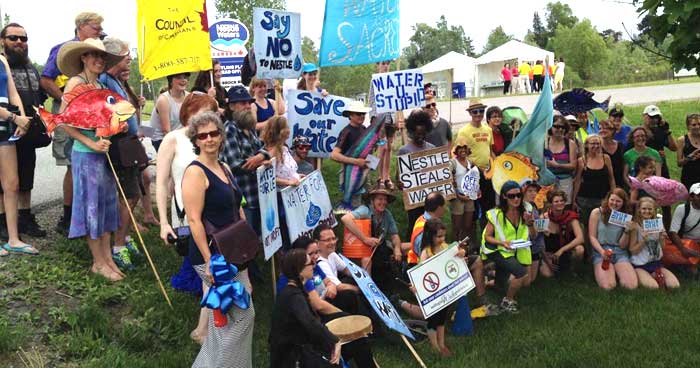
And last week we were going to talk about Nestle Foods getting out of the water bottling business in Canada, a major victory after a years’ long campaign. But we ran out of time. This week Vi Bui from the Council of Canadians talks about the victory and what’s next. See Canadians.org
Download or listen to the July 28 EcoCentric here:
Environment News to July 28 ’20
A new report from Australia paints a grim picture for the amount of wildlife affected by Australia’s devastating wildfire season. Nearly 3 Billion animals are thought to have died or been displaced by the fires, found a team of scientists from Australia’s top universities.
The fires ravaged more than 115,000 square kilometres (44,400 square miles) of drought-stricken bushland and forest across Australia in late 2019 and early 2020, killing more than 30 people and destroying thousands of homes. Scientists warn that global warming is lengthening Australia’s summers and increasing the danger for bushfires.
Greta Thunberg has accused EU politicians of failing to acknowledge the scale of the climate crisis and said its €750bn Euros Covid-19 recovery plan does not do enough to tackle the issue.
The climate campaigner said the package of measures agreed by EU leaders proved that politicians were still not treating climate change as an emergency.
“They are still denying the fact and ignoring the fact that we are facing a climate emergency, and the climate crisis has still not once been treated as a crisis,” Thunberg told the Guardian. “As long as the climate crisis is not being treated as a crisis, the changes that are necessary will not happen.”
Mexico and the state of Texas were hit hard by hurricane Hanna, while the state of Hawaii was spared the worst of hurricane Douglas.
Hanna became the first hurricane of the North Atlantic hurricane season before it was downgraded to a tropical storm. After making landfall in Texas, the tropical depression moved into Mexico, flooding cities
In Hawaii, hurricane Douglas appears to have barely missed the islands; however meteorologists caution that the hurricane’s path could shift slightly and unleash carnage on the islands of Oahu and Kauai.
Hawaii has some of the lowest coronavirus infection rates in the United States, but numbers have been rising in recent weeks.
Conversely, Texas has one of the highest infection rates in the nation. Worries are also growing for the wellbeing of some 1,300 asylum seekers stranded in a camp on the Mexico side of the border by US immigration.
https://www.cbc.ca/news/world/hurricane-douglas-hawaii-1.5664042
https://www.washingtonpost.com/weather/2020/07/27/hurricane-douglas-hawaii/
Still in the United States, a group of progressive Democrats introduced a bill Friday that would stop fossil fuel companies from receiving billions of taxpayer dollars in subsidies and federal coronavirus relief funds.
The bill was presented by a group including Minnesota Congressmember Ilhan Omar and Vermont Senator Bernie Sanders. The bill, dubbed the “End Polluter Welfare Act of 2020”, is unlikely to gain much traction in Congress, where the House is controlled by industry-friendly Democrats and Republicans hold the Senate.
The progressive coalition makes the argument that the richest country in the world has failed to provide adequate medicare or COVID-19 economic relief, but has continued to give oil, gas and coal companies nearly $15 billion per year in direct federal subsidies and already directed billions more in support through coronavirus relief programs this year.
A new investigation by the left-leaning Public Accountability Initiative reveals major polluters and financial institutions are also funding powerful police groups across the U.S.
The companies include Chevron, Shell, and Wells Fargo, which pour money into police foundations in cities including Seattle, Chicago, Washington, New Orleans and Salt Lake City.
The report notes that Americans of color, who are victims of police brutality at higher rates than the general population, are also disproportionately impacted by pollution.
In tech news, Apple Computers this week unveiled its plan to become carbon neutral by 2030.
The company says it is already carbon neutral for its global corporate operations. The new commitment will mean that by 2030, every Apple device sold will have net zero climate impact.
Tim Cook, Apple’s CEO said “Businesses have a profound opportunity to help build a more sustainable future, one born of our common concern for the planet we share,”
The Doug Ford government in Ontario passed its economic recovery legislation last week, but the provincial Auditor General Bonnie Lysyk said the massive omnibus bill could violate the province’s Environmental Bill of Rights.
Bill 197, a 188-page measure tabled July 8, amended 20 separate pieces of legislation. It was adopted just two weeks later, despite analysts’ concern that its up-front focus on transit-oriented development, affordable housing, air conditioning in long-term care homes, and even education policy was what some called a “Trojan horse” for rolling back environmental protections.
A Yukon First Nation is receiving federal funding to build environmental resilience.
On July 22, the federal government announced $600,000 for 10 Indigenous guardian projects across the country. This marks the third year of its Indigenous Guardians pilot program, which provides funding for Indigenous communities to monitor and protect the environment as they see fit.
Kluane First Nation is the only northern project picked this year. The First Nation will establish a program with three guardians, building on an environmental monitoring program that the nation previously established and funded internally.
The West Kootenays is bracing for a soaring heatwave this week.
Environment Canada issued a special weather statement Friday afternoon, as the southern Interior is projected to bake until Wednesday.
The public is being advised to Stay cool and hydrated, particularly during the hottest period of the day from 1pm to 5pm, and limit outdoor activity.
On a similar note, the province has banned Category 2 and category 3 fires in the southeast as of July 24.
Bon fires, fireworks, and the burning of waste or slash piles are all banned in order to reduce the risk of wildfire.
Campfires up to a half-metre high by a half-metre wide, are still allowed, as well as cooking stoves that use gas, propane or briquettes.
Visit bcwildfire.ca for information on current wildfire activity, burning restrictions, road closures and air quality advisories.
 Longest running Enviro News show on the Radio!