

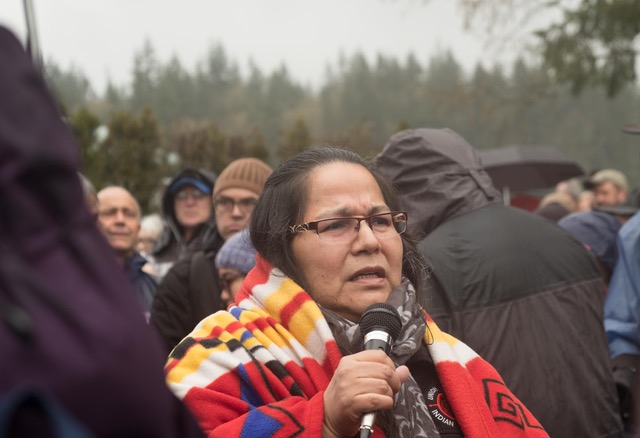
Talking about the future is hot these days… David Suzuki, Naomi Klein and other voices look at it on the show. But, the present: the latest clusters of Covid in BC have come from the Kearl Lake tar sands mine workers returning to their families. The High River Cargill plant has spawned 900 cases all by itself. But in BC major industrial camps continue, as John Horgan proudly pointed out last week. How long before they seed clusters of Covid too. The Union of BC Indian Chiefs raised concerns about the impact of big work camps. Secretary Treasurer Chief Judy Wilson explains their concerns.
The Canada-wide Climate Caucus initiated by Nelson’s Rik Logtenberg held a webinar last week with David Suzuki, Melina Laboucan-Massimo and others. We’ve got an inspiring clip of David Suzuki from that online event.
And poetry! The Great Realisation, a charming young Dad’s bedtime story of hope for the children. Catch it on youtube!
Listen to the full show here:
Environment News for May 5, 2020\[audio
Despite the Covid-19 outbreak, the planet is still a long way from global cooling and a return of glaciers. While the flow of anthropogenic greenhouse gases is decreasing, the stock is still rising.
Early estimates for global emission reductions for 2020 vary widely. A conservative emissions reduction research by The Breakthrough Institute estimates a thin 0.5% to 2.2% reduction in CO2 emissions, while the International Energy Agency is predicting global greenhouse gas emissions will drop a record 8% this year.
The Mona Loa Observatory in Hawaii, which measures global atmospheric CO2 concentration, has reported an overall increase since February 26th, with no Covid-19 signal yet observed. This is partly due to the seasonal decrease in global carbon sequestration in cooler northern hemisphere months, but also because even deeper emission-cutting measures are required than those currently in place under Covid-19 in order to tackle the climate crisis.
Additionally, the IEA warns emissions may soar again unless governments invest now in clean energy.
http://geographical.co.uk/nature/climate/item/3641-real-impact-climate
_____________________________________
The National Oceanic and Atmospheric Administration says 2020 is on track to become the hottest year ever recorded, topping 2016.
Areas of the south-western United States are poised to shatter April heat records. Temperatures in Las Vegas, Nevada and Phoenix, Arizona are expected to shatter 3-digit records. High temperatures in Florida
This January was the hottest on record, leaving many Arctic nations without snow in their capital cities. In Russia, new wildfires have erupted in central Siberia, with temperatures soaring by as much as 36 degrees Fahrenheit above normal.
_____________________________________
Concern about the 2020 Wildfire season is growing in British Columbia, among fears of the Coronavirus epidemic. Wildfire smoke contains tiny particulates known as PM2.5 that can embed deep into lungs and lead to a host of negative health effects, according to the World Health Organization.
“Deterioration in air quality may lead to more COVID-19 infections overall … (and) more cases of severe COVID-19 infections and add further demand to our health care system,” according to a March 26 advisory from B.C.’s Ministry of Environment and Climate Change Strategy.
Although BC saw relatively mild wildfires last year, both 2017 and 2018 were record-breaking seasons. A report co-authored by fire research agencies in Canada, Mexico, and the USA predicts warm temperatures to begin covering large portions of Canada in June, with rainfall being the most important variable. Low rainfall or even slightly low rainfall in June will likely increase fire potential.
http://www.predictiveservices.nifc.gov/outlooks/NA_Outlook.pdf
_____________________________________
Although the Tour de France has been cancelled in 2020 due to COVID-19 concerns, French commuters are being urged to swap cars for bicycles when the Covid-19 lockdown ends.
The government has announced plans to develop temporary bike lanes, with an additional €20m subsidy towards the cost of repairs.
The initiative, by the energy and transport ministry, also includes an increase in bicycle parking spaces and training to get people back in the saddle.
The “bicycle repair boost” programme, which will provide up to €50 for repairs by sponsored mechanics, as well as supporting a scheme that allows employers to cover up to €400 of travel costs of staff who commute by bike. Paris currently has about 370km of bike paths and the temporary lanes are expected to increase that to 650km.
_____________________________________
The Coldwater band near Kamloops is calling for federal intervention after Trans Mountain announced it was changing the way it would study the aquifer the First Nation relies on for its drinking water.
In a letter to the federal government, Chief Lee Spahan wrote that he sees “a crisis is emerging with Trans Mountain failing to live up to previous commitment it has made to properly study our aquifer.”
Coldwater, a band within the Nlaka’pamux Nation whose reserve is located about 100 kilometres southwest of Kamloops, B.C., has concerns about the route of the twinned pipeline and how it might impact the source of drinking water in the community.
The National Energy Board (now Canada Energy Regulator) tasked Trans Mountain with completing a hydrogeological study of the aquifer that flows beneath and around Coldwater, under its conditions of approval for its pipeline expansion, before starting construction in the area.
Coldwater’s concerns have been at the forefront of two Federal Court of Appeal cases focused on the expansion as well as regulatory hearings where the band has argued for a route change to avoid the aquifer entirely.
The existing Trans Mountain pipeline runs through the Coldwater reserve and there is a spill site on the reserve that has yet to be remediated. Trans Mountain plans to construct its expansion line just outside the reserve boundaries.
https://www.cbc.ca/news/indigenous/coldwater-transmountain-aquifer-study-1.5547204
 Longest running Enviro News show on the Radio!