

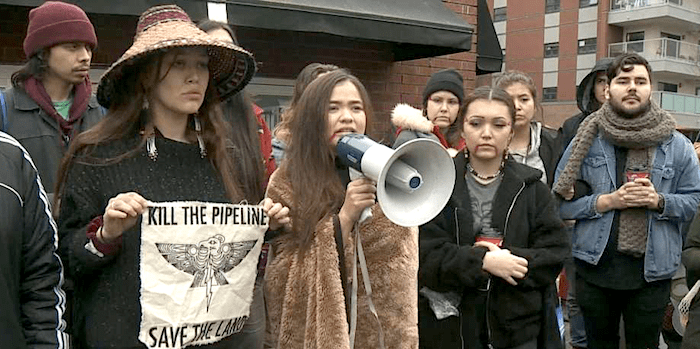
More coverage of the wave of messaging and solidarity with the Wet’suwet’en asserting sovereignty over their territory near Houston BC. Local activists Andy Shadrack talks about the crisis in BC reconciliation.
Teck Resources has proposed the Frontier Mine near the border of Wood Buffalo National Park, and it would be the largest tar sands mine. Sven Biggs, campaigner from Stand.Earth in Vancouver, talks about Federal cabinet decision on approval of the project.
Listen Here:
Environment News
Background on Wet’suwet’en Crisis
The crisis continues in Wet’suwet’en territories on the proposed route of the LNG pipeline. Last week there protests and statements from many sides.
There was a small protest last Friday outside the Nelson Courthouse and there is another one planned there for NOON this Friday, January 31.
We offer here a short primer… dipping into a little of the debate that is running hot and furious right now.
A week a group of Indigenous youth from several BC First Nations occupied Michelle Mungall’s political office of Energy, Mines and Petroleum resources in Victoria. They demanded the BC government respect Wet’suwet’en law stop construction of the Coastal Gas Link and meet with Wet’suwet’en leaders.
They occupied the office overnight and after 15 hours police arrested and removed 12 protestors, some of whom they had to carry out of the offices.
The youth issued a detailed statement here’s just part of it.
________________________________________________
The decision from the BC Supreme Court to extend CGL’s injunction order is a criminalization of Wet’suwet’en law and directly violates their constitutionally protected rights to occupy their own unceded lands
As Indigenous youth we stand with Wet’suwet’en assertion of sovereignty because we understand that Indigenous Peoples will cease to exist without our land; our languages, cultures, and future generations cannot survive without our it. Indigenous youth are not only inheriting a climate crisis driven by fossil fuel projects like CGL, but Canada’s legacy of colonization, genocide, and gendered violence against Indigenous women, girls, and Two-Spirit people. In protecting the lands from industrial development, we are protecting our bodies from violence.
__________________________________
That was from First Nations youth who occupied Michelle Mungall’s Ministry of Energy, Mines and Petroleum resources a week ago. The group included high profile youth activist Takaiya Blaney.
It was just a year ago, in January of 2019 when an RCMP tactical force violently arrested people on Wet’suwet’en territory near Houston. Recent revelations came out in the Guardian that the tactical force had been authorized to shoot people at that time.
Late this December the five Wet’suwet’en clan chiefs evicted the employees working on the Coastal Gas Link pipeline. The company immediately went to BC Supreme Court and got an injunction allowing them access to continue work. That ruling has been very controversial as it pits BC law directly against Wet’suwet’en law.
Last week despite doing a northern tour last week, Premier John Horgan refused to meet the Wet’suwet’en leaders.
Dozens of academics and lawyers from across Canada have signed a letter urging the provincial and federal governments to meet directly with the Wet’suwet’en hereditary chiefs and open a nation-to-nation dialogue in the hopes of peacefully resolving the matter.. Here’s part of what they said in their open letter last week.
___________________________________
Premier Horgan’s insistence on the “rule of law” fails to acknowledge that the relevant law includes not just the injunction order but the Constitution, Supreme Court decisions, and – crucially – Wet’suwet’en laws and institutions. The laws of Indigenous Peoples, including the Wet’suwet’en, predate those of Canada, are equally authoritative, and are entitled to respect. In an age of truth and reconciliation, respect for the rule of law must include respect for the authority of Indigenous law and a commitment to work out a just and sustainable relationship between Indigenous and settler Canadian legal systems.
More than twenty years ago, Chief Justice Lamer, writing for Supreme Court, recognized the Crown’s moral duty to engage in good faith negotiations with the Wet’suwet’en to resolve the issue of ownership and jurisdiction over their ancestral lands. This apt statement is reinforced by the growing appreciation that these negotiations are between two systems of legal and political authority. Reconciliation and justice cannot be achieved by relying on the RCMP or resource companies to do the Crown’s work.
https://ricochet.media/en/2887/open-letter-to-justin-trudeau-and-john-horgan
___________________________________
That was from the detailed statement issued last week by a long list of Canadian academics and lawyers.
Last Friday, independent member of Parliament JODY WILSON-RAYBOULD published an opinion piece in the Globe and Mail asking Who speaks for the Wet’suwet’en people? While First Nation band councils have signed off on the pipeline, the broader Wet’suwet’en nation has not. Jody Wilson-Raybould makes this very clear.
___________________________________
The legal reality is that band councils are a creature of the colonial Indian Act and have limited delegated authority tied to reserves. They do not have inherent authority, nor are they self-governing or an expression of self-determination. They cannot simply represent the proper rights holder – the broader group that shares a common language, culture and tradition – and typically there is more than one band within a given territory of an Indigenous people. As part of nation and government rebuilding, Indigenous peoples may self-determine to adopt aspects of the band council system or have them represent the peoples with respect to title and rights – but that is up to them. This is not a choice for government or industry.
She also says: Reconciliation requires transitioning from the colonial system of government imposed on First Nations through the Indian Act, to systems of Indigenous governance that are determined by Indigenous peoples and recognized by others. Indigenous peoples must do this work.
_____________________
 Longest running Enviro News show on the Radio!