Paul Cienfuegos from CommunityRights.US talks about the movement of local governments exerting authority on local concerns, particularly local environmental concerns. He suggests it might offer a strategy for local control of logging. Naturalist Joanne Siderius from the Kokanee Nature Centre at Kokanee Creek Provincial Park tells us what a great season they’ve had. Environment News and more…
Environment News for September 3, 2019
Tuesday, August 27 there was an injunction hearing in court in Nelson between Cooper Creek Cedar and four Watershed Protectors. At issue was the Water Protectors camp talking to timber cruisers on Salisbury Creek between Argenta and Johnson’s Landing. The mountainside above Kootenay Lake is part of the area that the WilletWildernessForever.ca campaign is pushing to add to the Purcell Wilderness Conservancy. It’s also where evidence of more mountain caribou was found this spring. This is the Purcell herd which was declared extinct last winter. The judge issued an injunction with an enforcement order to stop anyone from impeding Cooper Creek Cedar from working to get the maximum annual allowable cut for 2020.
____________________
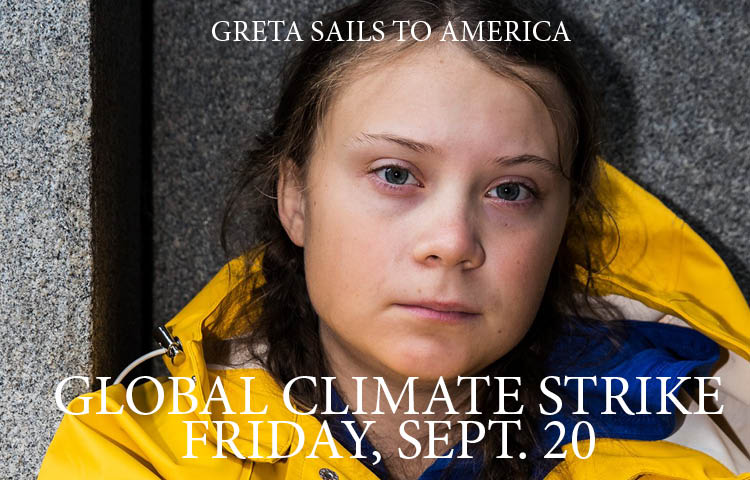
Teenage Climate Strike leader Greta Thunberg has finally arrived in New York after a two week ship voyage across the Atlantic. She also headed straight to the United Nations for a Friday protest! Things are gearing up around the world for the International Climate Strike from September 20 to 27
In Vancouver the Strike is organized by the Sustainabiliteens and Climate Strike Canada – students are organizing daily actions in Vancouver culminating in a mobilization starting at 1pm at Vancouver City Hall on Friday, September 27. They will be walking out of class in large numbers across the Lower Mainland and are “calling on parents, unions, businesses, and the general public to join us in an international #EarthStrike for climate action.”
____________________
The federal and British Columbia governments want to power the production of the natural gas industry in the province using electricity.
As part of an agreement announced last week. Along with BC Hydro are they forming a committee to push projects that increase power transmission.
Prime Minister Justin Trudeau said the agreement is aimed at reducing greenhouse gas emissions from the natural gas industry, which produces about 18 per cent of the carbon pollution in the province.
In reality the plan is to use Site C electricty to power the compressors that make natural gas into a liquid… LNG.
B.C. Premier John Horgan joined Trudeau in making the announcement on Thursday at a BC Hydro training centre in Surrey, saying the two governments are working to make the economy more environmentally sustainable.
https://www.cbc.ca/news/canada/british-columbia/trudeau-horgan-surrey-announcement-1.5264467
____________________
The Jumbo Glacier Ski resort project must finally be dead. Last week The federal Liberal government announced they will offer the Ktunaxa First Nation more than $16 million to protect the Jumbo valley
CBC News reported the federal Liberal government was annoucning the fund to help the Ktunaxa protect the area, which covers 211,045 hectares in the central Purcell Mountains where developers had planned to build the Jumbo Glacier Resort.
The report was the money will be used by the First Nation to assess and identify cultural values, biodiversity and develop boundaries in the area, which includes spectacular snow-capped mountains and glacier-fed lakes.
The Ktunaxa call Jumbo Qat’muk, and say it’s home to the grizzly bear spirit.
Two years ago, the East Kootenay First Nation went to the Supreme Court of Canada to try to have the proposal quashed for a year-round ski resort at Jumbo. The Ktunaxa argued it would irreparably harm their spiritual beliefs and practices — a violation of their Charter right to religious freedom. The Ktunaxa lost the Supreme Court case.
____________________
Catherine McKenna, federal and environment climate change minister, said the carbon tax, which currently stands at $20 a tonne, or about four cents a litre, will stop once it reaches a piffling $50 a tonne, or about 11 cents a litre, three years from now.
Canada’s Ecofiscal Commission, which exists to study the issue, reckons the carbon tax must rise to between $125 and $175 a tonne (between roughly 27 to 38 cents per litre of gas, or $16 to $23 for a 60-litre fillup) before Canadians will change their behaviour enough to meet the government’s target of returning to a level of greenhouse gas emissions that is 30 per cent below 2005 levels by 2030.
https://www.cbc.ca/news/opinion/carbon-tax-honesty-1.5179049
____________________
Last week The Trump administration announced plans to cut back on the regulation of methane emissions, a major contributor to climate change.
The Environmental Protection Agency’s proposed rule aims to eliminate federal requirements that oil and gas companies install technology to detect and fix methane leaks from wells, pipelines and storage facilities. It would also reopen the question of whether the E.P.A. had the legal authority to regulate methane as a pollutant.
Global methane emissions rose steeply in the last decades of the 20th century and then leveled off. But around 2006, they started heading up again. Why? What was the source? Scientists were baffled. (Jonathan Mingle wrote a great story for Undark on scientists’ search for answers.)
There are two broad sources of methane emissions: biogenic (plant and animal-based) and fossil fuel production. The former is mainly about agriculture (cow burps, pig poop, rotting organic waste) and tropical wetlands. As for the latter, methane is leaked or deliberately “flared” (burned off) at virtually every stage of fossil fuel production and transport, a problem that is notoriously bad for fracked shale gas and tight oil.
____________________
 Longest running Enviro News show on the Radio!