

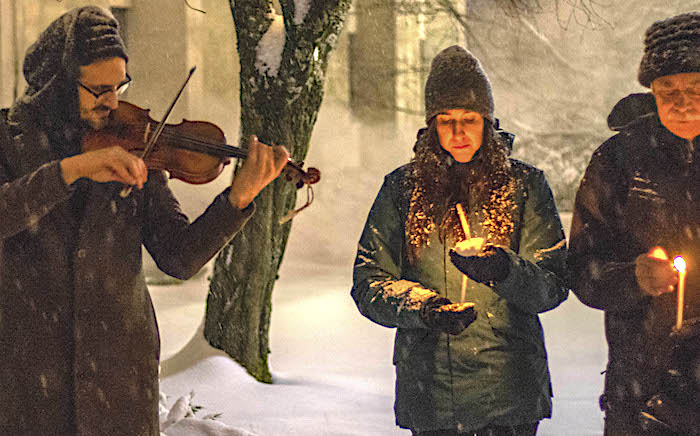
Rory Gallagher tells us how his new heat pump is cutting electricity costs and providing clean heat in their house. Heather McSwann reports on the court ruling against an injunction to forestall logging in the Glade Watershed. We hear about the vigil for the lost caribou and Okanagan and West Kootenay MP Richard Cannings talks about the destructive sulphuric acid spill in Trail.
The Environment News for Feb. 19 2019
A recent study, led by researchers at University of California, Berkeley and Friends of the Earth, tracked pesticide levels in four families from across the country for two weeks. The first week, the families ate their typical diets of non-organic food; the following week, they ate completely organic. Urine samples taken over the course of the study were tested for pesticides and the chemicals pesticides break down into, called metabolites.
Of the 14 chemicals tested, every single member of every family had detectable levels. After switching to an organic diet, these levels dropped dramatically. Levels across all pesticides dropped by more than half on average. Detectable levels for the pesticide malathion, a probable human carcinogen according to the World Health Organization, decreased a dramatic 95% .
__________________________
According to an open letter posted on the Huu-ay-aht First Nation webpage, Steelhead LNG has stopped work on the Kwispaa LNG project.
The news was confirmed by Chief Robert Dennis Sr. In the letter, the Nation stated they would “evaluate the implications of this decision by Steelhead LNG” and “identify all go-forward options.” No reasons were given for the halt of the project.
The LNG project is a 730 hectare natural gas liquefaction and export facility on Sarita Bay, about 45 kilometres south-southwest of Port Alberni, fed by a 1000 km pipeline from near Chetwynd. The project has been estimated to cost $18 billion for export of 24 million tons of liquid natural gas per year at full build-out, requiring six to seven LNG carrier ships weekly.
The Kwispaa LNG project is a partnership project by Steelhead LNG of Vancouver, and Huu-ay-aht First Nations on West Vancouver Island.
https://watershedsentinel.ca/articles/kwispaa-lng-project-halted/
__________________________
A motion requesting the province cease licensing groundwater for commercial water bottling and bulk water exports was unanimously passed by the central Vancouver Island regional district of Strathcona on January 24.
Currently, the motion applies only to the Strathcona Regional District, but will be heard again at an April meeting of the Association of Vancouver Island and Coastal Communities (AVICC). If it is passed there, the motion will become island-wide, and be considered as a unified request by the Union of British Columbia Municipalities.
Brenda Leigh, Strathcona Regional District Area D director, and architect of the motion said
“There’s 29 regional districts in British Columbia, and a lot of them have been impacted by corporate extraction of their water supply,” said Leigh. “This is very important because the commodification of water in Canada means that we’re putting our water sources at risk.”
______________________________________
Recently, 236 radiation-research scientists from around the world have signed a petition charging that 5G cell service will be “massively increasing” the general population’s radiation exposure. And it’s not just humans that are endangered by this.
Dr. Joel Moskowitz, a University of California-Berkeley public health professor, told the UK’s Daily Mail (May 29, 2018) that the deployment of 5G “constitutes a massive experiment on the health of all species.”
In order to facilitate faster data-transfer speeds, 5G will utilize millimeter waves (MMWs), smaller waves accessed through a higher frequency of the electromagnetic spectrum not previously used by the telecom industry. These smaller waves cannot travel far, nor can they penetrate many types of materials. So this means that there will need to be millions of “small cell towers” (about the size of a refrigerator) close together – within a few feet of one another on every street.
Until now mobile broadband networks have been designed to meet the needs of people. But 5G has been created with machines’ needs in mind, offering low-latency, high-efficiency data transfer…. We humans won’t notice the difference [in data transfer speeds], but it will permit machines to achieve near-seamless communication. Which in itself may open a whole Pandora’s box of trouble for us – and our planet.
https://watershedsentinel.ca/articles/5g-corporate-grail/
__________________________
On February 19, the Full Snow Supermoon will hypnotize earth with its brilliance. Adbuster is calling on folks to close our laptops. Turn off the TV. Leave phones at home for a whole 24 hours. For one day, we free our inundated minds from digital distractions. We regain resilience, explore the quiet moments, experience solitary introspection again. We even dare to let ourselves feel boredom — it is here, in this biotic space, where the boundless creativity and beautiful madness of our minds can dance again. Here, we will ready ourselves for these volatile times ahead.
__________________________
The narwhal.ca has a fascinating report that the North Cowichan municipality on Vancouver Island just discovered it owns 5,000 hectares on six mountains that is slated for logging. North Cowichan’s Municipal Forest Reserve is one of the largest municipally owned forests in North America, encompassing 25 per cent of the North Cowichan land base.
“[The North Cowichan municipal forest] came into the control of the municipality in the 1930s.
North Cowichan is part of the coastal Douglas-fir biogeoclimatic zone, one of British Columbia’s 18 ecological zones.
“It is one of Canada’s most threatened ecosystems,” says forest ecologist Andy MacKinnon. “It has less than one per cent original forest remaining, high percentages of urban and agricultural land, a relatively low percentage of protected areas and B.C.’s highest percentage of private land, by far.”
_____________________________
Wallace Broecker, a climate scientist who brought the term “global warming” into the public and scientific lexicon, died on Monday. He was 87.
Broecker, a professor in the department of earth and environmental science at Columbia, was among the early scientists who raised alarms about the drastic changes in the planet’s climate that humans could bring about over a relatively short period of time.
His 1975 paper “Climatic Change: Are We on the Brink of a Pronounced Global Warming?” predicted the current rise in global temperatures as a result of increased carbon dioxide levels — and popularized the term “global warming” to describe the phenomenon.
The geoscientist was also known for recognizing the global “conveyor belt,” a system of deep-ocean currents that circulate water between the continents.
https://www.npr.org/2019/02/18/695797869/grandfather-of-climate-science-wallace-broecker-dies-at-87
_____________________________
 Longest running Enviro News show on the Radio!